
Tetramerocerata
Remy, 1950
Family Guides
4Tetramerocerata is the largest order of pauropods, containing more than 900 across 11 . are characterized by four-segmented with two branches, six tergites covering the trunk, and typically nine pairs of legs. The order was established in 1950 to distinguish these pauropods from the morphologically distinct Hexamerocerata. Tetrameroceratans are fluid-feeders with adapted for sucking rather than chewing solid food.
Pronunciation
How to pronounce Tetramerocerata: /tɛˌtræməroʊˈsɛrətə/
These audio files are automatically generated. While they are not always 100% accurate, they are a good starting point.
Identification
Distinguished from the only other pauropod order, Hexamerocerata, by four-segmented (vs. six-segmented) that are not telescopic; six tergites (vs. twelve); typically nine leg pairs (vs. eleven); flat or convex temporal organs (vs. cup- or umbrella-shaped); and four pairs of pygidial setae (vs. five to eight). The collum bears two appendages with an intervening plate (vs. smooth in Hexamerocerata). The antennal branch has two and a globulus (vs. one flagellum and no globulus).
Images
Appearance
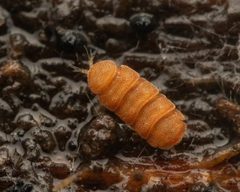
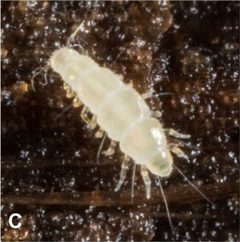
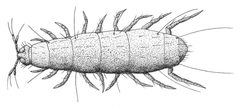
are minute myriapods, generally 0.5–2 mm in length, typically white or brown in color. The consist of four non-telescopic stalk segments, with two branches emerging from the end of the fourth segment: a branch bearing one and a branch bearing two long flagella ( and ) plus a spheroid sense organ (globulus) on its distal part. The bears two large, flat or slightly convex temporal organs on the lateral sides. The trunk has twelve segments but only six tergites, as the first, fourth, sixth, eighth, tenth, and twelfth segments are reduced and covered by the tergites of adjacent segments. The collum (first trunk segment) has two anteriorly projecting appendages with a plate between them. The (last trunk segment) bears four pairs of setae. Most adults have nine leg pairs, though some have eight and one genus has females with nine or ten pairs.
Distribution
Subcosmopolitan distribution, occurring worldwide except Antarctica. Pauropodidae and Polypauropodidae are especially widespread with subcosmopolitan ranges.
Diet
Fluid-feeding; are adapted for sucking and used to puncture walls. No solid food has been observed in the .
Life Cycle
Development proceeds through five post-embryonic instars. Juveniles begin with three leg pairs and three tergites, progressing through stages with five, six, and eight leg pairs before reaching adulthood with nine leg pairs and six tergites (in most ).
Similar Taxa
- HexamerocerataThe only other order in Pauropoda; distinguished by six-segmented telescopic , twelve tergites, eleven leg pairs, cup-shaped temporal organs, smooth collum, and solid food consumption.
More Details
Taxonomic history
The order was created by Remy in 1950 following the discovery of Millotauropus, which was found to have sufficiently distinctive features to warrant placement in a separate order (Hexamerocerata). Tetramerocerata contains approximately 99% of described pauropod .
Families
The order comprises 11 : Afrauropodidae, Amphipauropodidae, Antichtopauropodidae, Brachypauropodidae, Colinauropodidae, Diplopauropodidae, Eirmopauropodidae, Eurypauropodidae, Hansenauropodidae, Pauropodidae, Polypauropodidae, and Sphaeropauropodidae.
Leg pair variation
While most have nine leg pairs, four (Cauvetauropus, Aletopauropus, Zygopauropus, and Amphipauropus) have only eight pairs. Adult females in Decapauropus have either nine or ten pairs.