
Siphonorhinidae
Cook, 1895
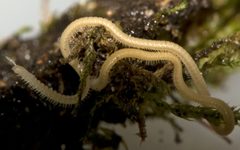
Siphonorhinidae is a of millipedes in the order Siphonophorida, characterized by super-elongated trunks with more than 180 diplosegments and leg counts exceeding 710 in some . The family includes the leggiest animal on Earth, Illacme plenipes, with females possessing up to 750 legs. Members are small, threadlike, slow-moving, unpigmented, and inhabit deep soil microhabitats. The family exhibits a fragmentary, disjunct distribution across California, southern Africa, Madagascar, the Malay Archipelago, Indo-Burma, and now Chile. Siphonorhinidae is represented in the Western Hemisphere solely by the Illacme in California and the newly described genus Notorhinus in Chile.
Pronunciation
How to pronounce Siphonorhinidae: /sɪfənoʊˈrɪnɪdi/
These audio files are automatically generated. While they are not always 100% accurate, they are a good starting point.
Identification
Distinguished from other by extreme leg count (highest in Animalia), threadlike unpigmented body, and deep soil . Diagnostic features include pear-shaped and elbowed , though these may need critical reexamination based on recent phylogenomic analyses. Distinguished from the related family Siphonophoridae by somatic and sexual characters; Siphonorhinidae is with respect to Siphonophoridae. The Notorhinus is distinguished from other Siphonorhinidae by arrangement of basiconica on antennae.
Images
Habitat
Deep soil microhabitats; endogean (subterranean) lifestyle. Found beneath stones, decaying oak logs, and within soil matrix at depths of approximately 3 cm. Oak woodland in California; degraded central highland rainforests in Madagascar; fragmented native forest in Chile; areas with thick fog accumulation, sandstone boulders, and fine sandy soil.
Distribution
Fragmentary, disjunct distribution: California (USA), southern Africa, Madagascar, Malay Archipelago, Indo-Burma, and Chile. Western Hemisphere representation limited to California (37°N) and Chile (38°S), showing antitropical disjunction. Closest relatives separated by continental drift since Pangaea more than 200 million years ago.
Life Cycle
Euanamorphosis: individuals emerge from with at least four leg pairs and incrementally add legged-segments during development, continuing even after sexual maturity. Some reach 182–330 rings through this ongoing segment addition.
Behavior
Very slow locomotion; burrows through soil using concertina-like fashion. Movement facilitated by compressible segments due to primitively unfused , extensible and flexible body, continuous metachronal wave gait, and action of concentric tubular rings sliding within one another. Longitudinal and oblique muscles pull rings together to facilitate forward locomotion.
Human Relevance
Subject of scientific interest due to holding record for most legs of any animal; Illacme socal discovered in Los Angeles metropolitan area highlights conservation concern for subterranean fauna threatened by urban development. Discovery of new emphasizes importance of preservation to prevent anonymous extinction.
Similar Taxa
- SiphonophoridaeOther in order Siphonophorida; Siphonorhinidae is with respect to this family based on phylogenomic analyses. Distinguished by somatic and sexual characters.
- PolyxenidaAnother order with elongated bodies, but with distinct including bristle-like setae and different preferences.
More Details
Phylogenetic Note
Siphonorhinidae is with respect to Siphonophoridae based on phylogenomic analysis from Marek et al. (2021), suggesting -level classification based on may need critical reexamination.
Conservation Concern
Subterranean fauna including Siphonorhinidae are grossly understudied and threatened by encroaching human settlement and loss. Conservation of these is of high importance.
Evolutionary Significance
The antitropical distribution pattern in the Americas (California and Chile) suggests these may be relicts of a once greater distribution that persisted due to similar climatic conditions, with relationships established more than 200 million years ago during Pangaea.
Sources and further reading
- BugGuide
- Wikipedia
- GBIF taxonomy match
- iNaturalist taxon
- NCBI Taxonomy
- Catalogue of Life
- The leggiest animal on Earth lives in the outskirts of Silicon Valley | Blog
- California | Blog
- millipede | Blog
- Uncategorized | Blog - Part 44
- Zookeys | Blog - Part 30
- A new species of Illacme from southern California (Siphonophorida, Siphonorhinidae)
- Madagascarhinus, a new genus of the family Siphonorhinidae with two new species from Madagascar (Diplopoda, Siphonophorida)
- Notorhinus floresi sp. nov. gen. nov.: The first records of Siphonophorida in Chile and Siphonorhinidae in South America (Colobognatha)