
Siphonophorida
Snout Millipedes
Family Guides
2Siphonophorida is an order of millipedes in the subclass Colobognatha containing two : Siphonophoridae and Siphonorhinidae. These millipedes are characterized by super-elongated, worm-like bodies with up to 190 segments and extreme numbers of legs—up to 750 in Illacme plenipes, the leggiest animal known. They lack and exhibit euanamorphosis, adding segments throughout life even after sexual maturity. The order shows a scattered, disjunct distribution across multiple continents including North America, South America, Africa, Madagascar, India, Southeast Asia, and Australia.
Pronunciation
How to pronounce Siphonophorida: /sɪfəˌnɒfɔrɪdə/
These audio files are automatically generated. While they are not always 100% accurate, they are a good starting point.
Identification
Distinguished from other orders by the combination of: extremely elongated body with many segments (often 100+); absence of ; simple, leg-like lacking complex specialization; presence of a beak-like snout in Siphonophoridae (absent in Siphonorhinidae); and euanamorphic development with continued segment addition after maturity. Siphonophoridae differs from Siphonorhinidae by having straight with sensory pits on antennomeres 5–6 and beak-like mouthparts, versus geniculate antennae lacking sensory pits and no beak in Siphonorhinidae.
Images
Appearance
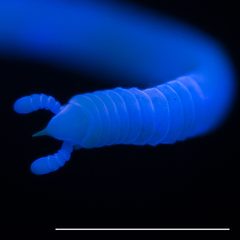
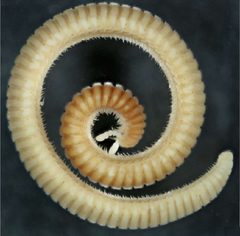
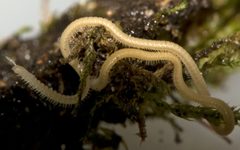
Elongated, thread-like, worm-shaped bodies reaching up to 36 mm in length with up to 190 body segments. are absent. Many in Siphonophoridae have the elongated into a long beak-like snout with highly reduced ; the beak may function in suctorial feeding. Body covered with dense fine setae. Each body segment consists of unfused tergite, two lateral pleurites, and sternite. Male (reproductive appendages) are simple and leg-like, composed of the ninth and tenth leg pairs with seven podomeres. straight with sensory pits on fifth and sixth segments in Siphonophoridae, or geniculate (elbowed) lacking such pits in Siphonorhinidae. Coloration typically pale or unpigmented.
Habitat
Deep soil microhabitats, endogean (underground) environments, and spaces. Found under decaying wood, stones, and within soil layers near leaf litter. North American Siphonorhinidae inhabit subterranean micro-; Chilean occur under decaying wood in fragmented native forest; Malagasy species occur in degraded central highland rainforests. Requires moist conditions with access to decaying organic matter.
Distribution
Scattered, disjunct distribution: southwestern USA to Brazil and Peru in the Western Hemisphere; South Africa; Madagascar; India; Southeast Asia; Indonesia (Java, Flores); and Australia. In the Americas, exhibits antitropical distribution at approximately 37° North (California) and 38° South (Chile). Siphonorhinidae: California (USA), southern Africa, Madagascar, India, Southeast Asia, Malay Archipelago, Indo-Burma, and Chile. Family Siphonophoridae: more widespread in Neotropics and other regions. Fossil record includes Late Cretaceous (Cenomanian) Burmese amber assignable to extant Siphonophora.
Life Cycle
Euanamorphosis: individuals emerge from with at least four leg pairs and incrementally add legged segments during development, continuing even after sexual maturity. Gradual development of with continuously changing shape between stadia leading to adulthood. This developmental mode is a key synapomorphy of the order.
Behavior
Very slow locomotion. Burrows through narrow underground crevices using concertina-like movement enabled by compressible segments due to primitively unfused , extensible flexible body, continuous metachronal wave gait, and action of concentric tubular rings sliding within one another. Longitudinal and oblique muscles pull rings together to facilitate forward locomotion. Burrowing resembles that of earthworms and geophilomorph .
Similar Taxa
- PolyzoniidaAlso exhibits super-elongation with many segments and euanamorphosis; of elongated body form in Colobognatha. Distinguished by different structure and .
- PlatydesmidaAnother colobognathan order with simple ; differs in having fewer segments and different body proportions.
- PolydesmidaLarge common order with many segments but with highly specialized, complex and different body shape; not euanamorphic.
More Details
Taxonomic difficulty
The simple, leg-like lacking complex specialization have led to Siphonophorida being called a 'taxonomist's nightmare'. Jeekel reportedly gave the order the 'taxonomists' award for least popular group among diplopods' due to the difficulty in distinguishing based on male genitalia.
Phylogenetic relationships
Siphonorhinidae is with respect to Siphonophoridae. The Illacme in California is the only representative of Siphonorhinidae in the Western Hemisphere; its closest known relative is Nematozonium filum in southern Africa, with divergence estimated at over 200 million years when continents were united in Pangaea.
Extreme leg counts
The order contains the leggiest animals on Earth: Illacme plenipes with up to 750 legs (females) and 562 (males); Eumillipes persephone with up to 1306 legs; and Illacme tobini with 414 legs. Leg proliferation may be an for burrowing or clinging to substrates.
Sources and further reading
- BugGuide
- Wikipedia
- GBIF taxonomy match
- iNaturalist taxon
- NCBI Taxonomy
- The leggiest animal on Earth lives in the outskirts of Silicon Valley | Blog
- California | Blog
- millipede | Blog
- Uncategorized | Blog - Part 44
- Zookeys | Blog - Part 30
- A new species of Illacme from southern California (Siphonophorida, Siphonorhinidae)
- Madagascarhinus, a new genus of the family Siphonorhinidae with two new species from Madagascar (Diplopoda, Siphonophorida)
- Notorhinus floresi sp. nov. gen. nov.: The first records of Siphonophorida in Chile and Siphonorhinidae in South America (Colobognatha)