
Orophe unicus
(Loomis, 1953)
Orophe unicus is a robust in the Xystodesmidae to the Rocky Mountains of northern Idaho. Originally described as Chipus unicus in 1953, it was transferred to Orophe in 1964 and has undergone taxonomic revision due to its close similarity to Orophe cabinetus. The is distinguished from its sister species primarily by subtle differences in structure and by geographic separation, though recent observations suggest their ranges may be closer than previously recognized.

Pronunciation
How to pronounce Orophe unicus: /oʊˈroʊfi ˈjuːnɪkəs/
These audio files are automatically generated. While they are not always 100% accurate, they are a good starting point.
Identification
Orophe unicus is superficially identical to its sister Orophe cabinetus. The two species can only be reliably distinguished by examination of male structure, which shows slight morphological differences. Geographic distribution provides additional supporting evidence, with O. unicus restricted to northern Idaho while O. cabinetus occurs elsewhere. Recent iNaturalist observations suggest the ranges may approach each other more closely than previously documented by Shelley (1993).
Images
Appearance
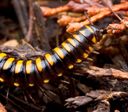
A robust Xystodesmid with brown to black background coloration on segments. Each segment bears a lighter yellow to orange spot on the caudal portion of the metatergite, with paranota matching this lighter color. The paranota of segments are broad and nearly contact adjacent segments, while paranota are narrower and widely separated. Paranota arise low on segments and are noticeably depressed, creating a domed overall appearance.
Habitat
Inhabits forested areas near rivers and creeks in the Rocky Mountains. Specific requirements or preferences remain poorly documented.
Distribution
to the Rocky Mountains of northern Idaho. Documented from southern Benewah and southeastern Shoshone counties, south through Latah and Clearwater counties into northern Idaho County. Recent observations extend the known range north and east into additional areas of Benewah and Shoshone counties, and north into Kootenai and Bonner counties. A small in Spokane County, Washington is of uncertain status.
Similar Taxa
- Orophe cabinetusSuperficially identical in general appearance; distinguished only by subtle differences in structure and primarily by geographic range, though ranges may be closer than previously recognized
More Details
Taxonomic history
The has undergone repeated taxonomic revision. R.L. Hoffman (1964) suggested the differences between O. unicus and O. cabinetus were minor and the relationship might be subspecific. Loomis and Schmidt subsequently synonymized O. unicus under O. cabinetus. Rowland Shelley reinstated O. unicus as valid in 1993 based on gonopod differences and the nature of the .
Range expansion
iNaturalist observations have documented the further north and east than recorded in Shelley (1993), including into Kootenai and Bonner counties, with a questionable record in Spokane County.