
Sigmocheir
Chamberlin, 1951
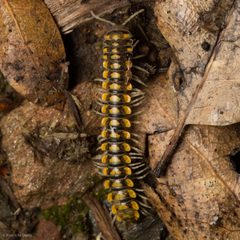
Sigmocheir is a of flat-backed millipedes in the Xystodesmidae, to the foothills of the Sierra Nevada mountains in California. The genus contains three : S. maculifer, S. calaveras, and S. furcata. All species share a distinctive color pattern of three lemon yellow spots per segment. The genus was established by R.V. Chamberlin in 1951, with a complex taxonomic history involving synonymies that were not fully resolved until 1995.
Pronunciation
How to pronounce Sigmocheir: //ˈsɪɡmoʊˌkaɪər//
These audio files are automatically generated. While they are not always 100% accurate, they are a good starting point.
Identification
Distinguished from other West Coast Xystodesmids by the combination of high paranota creating a flat appearance and the distinctive three-spot color pattern per segment (two lateral spots on paranota plus one central spot). The Sierra Nevada foothill distribution also helps narrow identification.
Images
Appearance
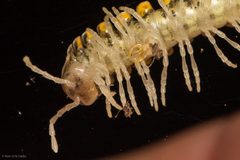
Sigmocheir millipedes have a flattened body profile due to paranota (lateral extensions) that arise high on each segment. Each segment bears three lemon yellow spots: one on each paranotum and a slightly wider central spot. This color pattern is consistent across all three in the .
Habitat
Foothills of the Sierra Nevada mountains in California. Specific microhabitat details such as moisture preferences or substrate associations are not documented in available sources.
Distribution
to California, USA. Range extends from Placer County south to the northern portion of Tulare County, following the Sierra Nevada foothills.
Similar Taxa
- Other Xystodesmidae genera in CaliforniaSigmocheir differs in its three-spot color pattern and high paranota that create a flattened profile; most other West Coast Xystodesmids lack this specific color arrangement and body shape.
More Details
Taxonomic History
The has a complex nomenclatural history. Chamberlin described Sigmocheir dohenyi in 1953, but in a second 1953 paper seemingly described the same specimen as Tuolumnia dahenyi, creating a synonymy. The genus was fully resolved in 1995 when Rowland M. Shelley moved Paimokia maculifer to Sigmocheir and described S. furcata as a third .
Cave Associations
The was collected from Crystal-Stanislaus Cave in 1950, and additional early specimens came from Crystal Palace Cave, suggesting at least some inhabit cave or subterranean environments.