
Sigmoria ainsliei
(Chamberlin, 1921)
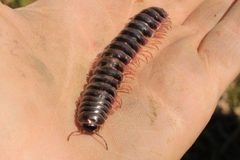
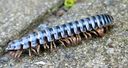
Sigmoria ainsliei is a large flat-backed millipede in the Xystodesmidae, to a narrow region of eastern Tennessee. First described in 1921, it is one of the largest xystodesmid millipedes in North America, with exceeding 50 mm in length. The has a highly restricted distribution spanning approximately 50 km from the Great Smoky Mountains National Park to Knoxville.
Pronunciation
How to pronounce Sigmoria ainsliei: /sɪɡˈmɔːriə ˈeɪnsliaɪ/
These audio files are automatically generated. While they are not always 100% accurate, they are a good starting point.
Identification
The combination of large size (>50 mm length, >12 mm width), red paranota, and occurrence within its restricted Tennessee range distinguishes this from other Sigmoria and Apheloriini. The only other large xystodesmid in the region, Apheloria virginiensis, typically has yellow or orange paranota with black markings rather than solid red.
Images
Appearance
reach lengths greater than 50 mm and widths exceeding 12 mm, making this among the largest xystodesmid millipedes. Individuals typically possess red paranota (lateral extensions of the body segments).
Habitat
In the Great Smoky Mountains National Park, occupies moist soils in rhododendron groves. Where this microhabitat is unavailable, found beneath leaf litter in hardwood forests. Requires humid conditions with abundant decaying organic matter.
Distribution
to eastern Tennessee. Documented from Knox, Sevier, and Blount counties. Range extends from State Route 73 in Great Smoky Mountains National Park northward to just north of the French Broad River in Knoxville. Suspected but unconfirmed in Loudon County due to limited suitable .
Diet
Feeds on decaying organic matter in soil and leaf litter. Competes with Asian jumping worm (Amynthas agrestis) for food resources.
Ecological Role
Contributes to decomposition and nutrient cycling in forest . Serves as an for intact, mature forest with minimal disturbance. Competition with earthworms may affect .
Human Relevance
Subject of conservation concern due to restricted range and specificity. The specimen is housed at Harvard University's Museum of Comparative Zoology. Documented through citizen science platforms including iNaturalist.
Similar Taxa
- Apheloria virginiensisOverlaps in eastern Tennessee and similar large size, but distinguished by yellow/orange paranota with black markings versus solid red paranota in S. ainsliei.
- Sigmoria aberransOccurs in broader Appalachian range; generally smaller and with different coloration patterns.
More Details
Taxonomic history
First described as Apheloria ainsliei by Ralph V. Chamberlin in 1921. Transferred to Falloria before that genus was synonymized with Sigmoria. The was collected from Knox County, Tennessee.
Conservation status
Restricted range and specific requirements make this vulnerable to habitat loss and . Competition with Amynthas agrestis may reduce individual lifespan, though this interaction may also suppress worm .