
Paradoxosomatidae
Daday, 1889
flat-backed millipedes
Genus Guides
4- Akamptogonus
- Chondromorpha
- Orthomorpha
- Oxidus(greenhouse millipedes)
Paradoxosomatidae is the largest of flat-backed millipedes, containing nearly 200 and approximately 975 as of 2013. It is the sole family in the suborder Paradoxosomatidea. Members are distinguished by grooves on most body segments and a dumb-bell shaped aperture in males. The family includes notable groups such as the dragon millipedes of Southeast Asia and the widely introduced greenhouse millipede Oxidus gracilis.

Pronunciation
How to pronounce Paradoxosomatidae: //ˌpæɹəˌdɒksɔˈsɒmətɪdiː//
These audio files are automatically generated. While they are not always 100% accurate, they are a good starting point.
Identification
Paradoxosomatids can be distinguished from other polydesmidan millipedes by the combination of: present between paranota on most segments; second segment paranota positioned lower than collum and third segment paranota; and males with dumb-bell shaped aperture. The is further characterized by male projections on the fifth sternite in most . Dragon millipedes in the Desmoxytes are recognized by their spiky, spine-like projections and often bright aposematic coloration.
Images
Appearance
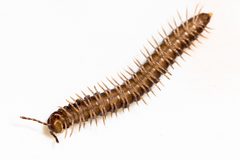
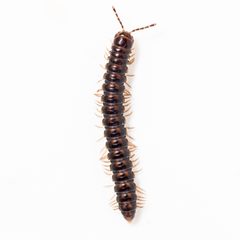
Paradoxosomatids are flat-backed millipedes with a distinct groove or furrow () between the keels (paranota) on most body segments. The keels of the second body segment are positioned lower on the body than those of the first segment (collum) and third segment. possess 19 or 20 body segments in addition to the . Ozopores (defensive gland openings) are located on the lateral margins of keels, typically on segments 5, 7, 9, 10, 12, 13, and 15 through the last segment. Males have a dumb-bell or hourglass-shaped aperture on the underside of the body, and most have one or two projections on the sternite of the fifth body segment.
Habitat
Paradoxosomatids occupy diverse terrestrial including forest litter, soil, and caves. The greenhouse millipede Oxidus gracilis is strongly associated with human-modified environments such as greenhouses and agricultural settings. Cave-dwelling , particularly in the Desmoxytes, exhibit extreme adaptations including elongated legs and , and loss of pigmentation. Some species show highly localized distributions, with certain cave-dwelling known from single cave systems.
Distribution
Occurs on all continents except Antarctica. Native distributions span Europe, Asia, Africa, Australia, and South America. North American records north of Mexico are exclusively introduced . Notable introduced include Oxidus gracilis (native to Japan, now in greenhouses), Asiomorpha coarctata (native to Southeast Asia, introduced to tropics), and Chondromorpha xanthotricha (native to Sri Lanka or southern India, introduced to tropics).
Diet
feeding on decaying plant matter and leaf litter. Some may also consume fungi.
Life Cycle
Development involves gradual growth through moulting. have 19 or 20 body segments plus the . Specific details vary among ; cave-dwelling species typically have low numbers and restricted distributions.
Behavior
Some exhibit swarming . Dragon millipedes in the Desmoxytes produce toxic hydrogen cyanide as a chemical defense. Cave-dwelling species show reduced densities compared to other cave groups. The greenhouse millipede Oxidus gracilis is strongly associated with human-disturbed .
Ecological Role
Paradoxosomatids function as decomposers in soil , contributing to nutrient cycling through consumption of decaying plant material. As ancient soil , they play a role in soil and ecosystem functioning.
Human Relevance
The greenhouse millipede Oxidus gracilis is a widespread introduced associated with agricultural and greenhouse environments, sometimes considered a nuisance pest. Dragon millipedes, particularly the 'shocking pink dragon ' Desmoxytes purpurosea, have attracted public and scientific attention for their distinctive appearance. Some species serve as models for evolutionary and biogeographic studies due to their restricted distributions and cave adaptations.
Similar Taxa
- Other Polydesmida familiesParadoxosomatidae is distinguished by the combination of , dumb-bell shaped aperture, and specific paranotal positioning; other lack this particular suite of characters.
- Julidae (order Julida)Julid millipedes are cylindrical rather than flat-backed, lack paranota entirely, and do not possess the grooves characteristic of Paradoxosomatidae.
More Details
Taxonomic structure
The is divided into three and 22 tribes. The subfamily Paradoxosomatinae contains over 760 in 17 tribes, representing the majority of diversity. Subfamily Alogolykinae contains approximately 60 species in two tribes distributed in central, south, and southeast Asia. Subfamily Australiosomatinae contains approximately 140 species in three tribes from Southeast Asia and Oceania.
Conservation significance
Cave-dwelling paradoxosomatids, particularly dragon millipedes in the Desmoxytes, often exhibit extreme rarity and narrow , with some known from single caves or cave systems. These characteristics make them valuable for evolutionary studies but also vulnerable to disturbance.
Research history
The has been subject to extensive taxonomic revision, with numerous new described from China, Vietnam, Laos, and other regions in recent years. Molecular phylogenetic studies have revealed instances of introgressive hybridization in Australian representatives of the family.
Sources and further reading
- BugGuide
- Wikipedia
- GBIF taxonomy match
- NCBI Taxonomy
- cave diversity | Blog
- Diplopoda | Blog
- Uncategorized | Blog - Part 19
- Pensoft blog - Part 125
- Zookeys | Blog - Part 33
- A new species of the genus Chondromorpha Silvestri, 1897 and a catalogue of Paradoxosomatidae Daday, 1889 millipedes from Gujarat, India, along with their distributions and ecological perspectives (Diplopoda, Polydesmida, Paradoxosomatidae)
- Records about the alien millipede Oxidus gracilis (C. L. Koch, 1847) (Diplopoda: Polydesmida: Paradoxosomatidae) in continental Chile
- A review of the millipede tribe Tonkinosomatini (Diplopoda: Polydesmida: Paradoxosomatidae) from Vietnam
- Notes on Genus Chondromorpha Silvestri, 1897 (Diplopoda: Polydesmida: Paradoxosomatidae) with New Distributional Records
- Phylogenetic and morphological discord indicates introgressive hybridisation in two genera of Australian millipedes (Diplopoda, Polydesmida, Paradoxosomatidae)
- New species of Boreohesperus (Diplopoda, Polydesmida, Paradoxosomatidae) from north-western Australia
- The South Asian millipede genus Chondromorpha Silvestri, 1897 (Diplopoda, Polydesmida, Paradoxosomatidae, Sulciferini): redescriptions and synonymies
- Two complete mitochondrial genomes of the family Paradoxosomatidae (Diplopoda, Polydesmida) with phylogenetic implications.
- Review of the millipede genus Orthomorpha Bollman, 1893 (Diplopoda, Polydesmida, Paradoxosomatidae) in Cambodia, with new records and descriptions of three new species.
- Mountainous millipedes in Vietnam. V. The millipede genus Kronopolites Attems, 1914 (Diplopoda, Polydesmida, Paradoxosomatidae), with descriptions of two new species.
- Taxonomic review of the millipede genus Touranella Attems, 1937, with a redescription of the type species, T.gracilis Attems, 1937, and descriptions of three new species from Laos (Diplopoda, Polydesmida, Paradoxosomatidae).