
Cylindroiulus punctatus
(Leach, 1816)
blunt-tailed snake millipede
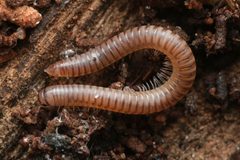
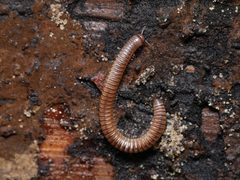
Cylindroiulus punctatus, commonly called the blunt-tailed snake , is a widespread European millipede in the Julidae. It is the most commonly recorded millipede in Britain and Ireland, strongly associated with woodland where it feeds on decaying wood and leaf litter. The exhibits seasonal vertical , in soil and moving to litter and logs during warmer months, with individuals sometimes found metres above ground in trees during summer. It takes three years to reach sexual maturity and can live for several additional breeding years. The species has been introduced to Newfoundland and Nova Scotia in North America.
Pronunciation
How to pronounce Cylindroiulus punctatus: //sɪˌlɪndroʊˈdʒuːləs pʌŋkˈteɪtəs//
These audio files are automatically generated. While they are not always 100% accurate, they are a good starting point.
Identification
and later stages possess a distinctive club-shaped caudal projection at the tail end, giving rise to the "club-tailed ." The body is brown with fine punctation (small dots) that can be difficult to see. The has approximately 100 legs and moves slowly.
Images
Habitat
Strongly associated with woodland , particularly dead and decaying wood and under the bark of dead trees. Occupies both decaying logs and soil, with seasonal movement between these microhabitats. Found in non-calcareous, commonly loamy soils. Shows negative association with , sand dunes, and grassland. In the British Isles, has a rural and semi-natural distribution.
Distribution
Native to western Europe, ranging from southern Scandinavia and the Shetland Islands to northern Spain and the Balearic Islands. Most commonly recorded in Britain and Ireland, found in nearly all parts of both islands. Generally a thermophilic lowland , though occur above 1000 m in northeastern Spain. Introduced to Newfoundland and Nova Scotia, Canada.
Seasonality
Seasonal vertical pattern: in soil, shifting to litter and logs during warmer months. By spring, individuals move into trees and may be found metres above ground during summer months.
Diet
Feeds on wood and leaf litter.
Life Cycle
Reaches sexual maturity at stadium VIII during the third winter. Females can breed for several additional years, reaching a maximum of 14 stadia. Mating and -laying occur during warmer months. Nests are constructed beneath the bark of fallen logs and stumps, found from May to August. Batches contain 45 to 60 eggs.
Behavior
Exhibits seasonal vertical between soil (winter) and litter/logs/trees (warmer months). and later stages display a club-shaped caudal projection.
Ecological Role
Decomposer in woodland , processing wood and leaf litter.
Sources and further reading
- BugGuide
- Wikipedia
- GBIF taxonomy match
- iNaturalist taxon
- NCBI Taxonomy
- Catalogue of Life
- Bug Eric: Spider Sunday: Phidippus octopunctatus
- ID Challenge #18 | Beetles In The Bush
- Euonymus peril - Euonymus leaf notcher, Pryeria sinica — Bug of the Week
- Anne Arundel County - This Bug's for You: The Euonymus Leaf Notcher, Pryeria sinica — Bug of the Week
- Yet another exotic invader: Euonymus leaf notcher, Pryeria sinicia — Bug of the Week
- Bug of the Week
- Seasonal Changes in the Distribution of the Millipede Cylindroiulus punctatus (Leach) in Decaying Logs and Soil
- The genome sequence of the club-tailed millipede, Cylindroiulus punctatus (Leach, 1816).