
Blaniulus guttulatus
(Fabricius, 1798)
Spotted Snake Millipede
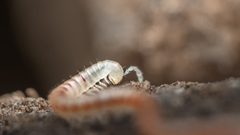
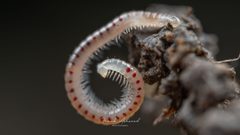
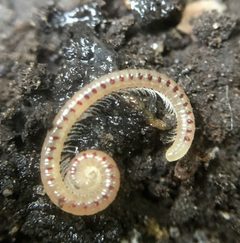
Blaniulus guttulatus, the spotted snake , is a small, eyeless millipede native to Central and Western Europe that has been widely introduced to North America, Australia, and remote Atlantic islands. It is characterized by its slender, pale body with distinctive red ozadenes (defensive glands) on each segment. The thrives in anthropogenic and can become an agricultural pest, particularly during drought conditions.
Pronunciation
How to pronounce Blaniulus guttulatus: //bləˈniː.jʊ.ləs ˌɡʌt.jʊˈleɪ.təs//
These audio files are automatically generated. While they are not always 100% accurate, they are a good starting point.
Identification
Distinguished from other European julid millipedes by the combination of: complete absence of ; extremely slender, thread-like body; and prominent red ozadenes on every segment. Similar in the Blaniulus and Blaniulidae may share the eyeless condition and pale coloration, but B. guttulatus is specifically identified by the consistent presence of conspicuous red ozadenes. The introduced range in North America and Australia helps narrow identification in those regions.
Images
Habitat
Common in gardens, cultivated areas, and agricultural fields. Thrives in disturbed, anthropogenic environments. Becomes more problematic as a pest during prolonged drought conditions.
Distribution
Native to Central and Western Europe (excluding Portugal). Introduced to: United States, Canada, Saint Helena, Tristan da Cunha, Tasmania, and Norfolk Island (Australia). Records also confirmed from the Azores (Corvo, Faial, Flores, Graciosa, Pico).
Diet
Feeds on sugar beets and other crop plants. Specific dietary breadth beyond cultivated crops is not well documented.
Life Cycle
Spends 3 years as a nymph before reaching maturity. Males mature at an earlier developmental stage than females.
Human Relevance
Agricultural pest of sugar beets and other crops, with damage exacerbated during prolonged drought conditions. Common in gardens and cultivated areas across its introduced range.
Similar Taxa
- Other Blaniulidae speciesShare eyeless condition and pale coloration, but B. guttulatus is distinguished by conspicuous red ozadenes on every segment