
Craspedosoma rawlinsii
Leach, 1814
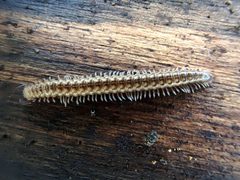
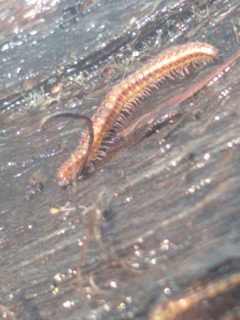
A small European in the Craspedosomatidae, notable as the first chordeumatidan introduced to North America. reach 15–16 mm in length with 30 body segments and distinctive reddish-brown coloration with dark markings. The species exhibits extreme morphological variability, leading to the description of numerous and varieties across its range.
Pronunciation
How to pronounce Craspedosoma rawlinsii: /kræˌspiːdoʊˈsoʊmə ˈrɔːlɪnˌsi.aɪ/
These audio files are automatically generated. While they are not always 100% accurate, they are a good starting point.
Identification
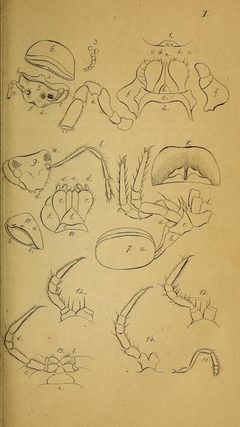
Distinguished from similar chordeumatid millipedes by the combination of 30 segments, smoothly rounded paranota creating a trapezoidal cross-section, and well-developed ocelli arranged in equilateral triangles. The reddish-brown coloration with dark line and amber paranotal margins is characteristic. structure, particularly the six processes of the gonopods, is diagnostic but requires microscopic examination. Extreme intraspecific variability in gonopod has led to multiple descriptions; continental European may require expert identification.
Images
Habitat
Primarily woodland , often associated with Alnus (alder); favors sandy soils and high humidity. Found in moist leaf litter, under stones, or beneath bark, frequently near water sources or reliably moist microhabitats. Occasionally recorded in coniferous forests and more open habitats. Known from elevations up to 1,540 meters in Switzerland.
Distribution
Native to Europe: recorded in Austria, Belarus, Belgium, Bosnia and Herzegovina, Bulgaria, Croatia, Czech Republic, Denmark, Estonia, Finland, France, Germany, Hungary, Ireland, Italy, Latvia, Lithuania, Luxembourg, Netherlands, Norway, Poland, Romania, Russia, Serbia, Slovakia, Slovenia, Sweden, Switzerland, and United Kingdom. Introduced to Canada: Quebec (Gatineau Park) and New Brunswick (Cornhill, Grand Bay-Westfield). Appears to be expanding northeastward in Europe, with recent records in Estonia and Latvia.
Seasonality
Present year-round; most commonly encountered during winter months.
Life Cycle
Development follows the typical diplopod pattern with anamorphic growth, though specific details of deposition, stages, and maturation timing are not documented.
Ecological Role
Functions as a in woodland , contributing to decomposition of leaf litter. In introduced Canadian , represents the only established member of the order Chordeumatida in North America, potentially filling an unoccupied .
Human Relevance
Subject of taxonomic debate regarding the correct spelling of its specific epithet (rawlinsii vs. raulinsii). The Canadian introduction marks the first recorded establishment of a chordeumatidan in North America. Named in honor of Richard Rawlins, who discovered the near Edinburgh, Scotland.
Similar Taxa
- Other Craspedosoma speciesRequire examination of for definitive separation; C. rawlinsii distinguished by specific arrangements of and gonopod processes
- Other ChordeumatidaMany share 30-segment body plan; C. rawlinsii identified by paranota shape, ocelli arrangement, and coloration pattern
More Details
Nomenclatural Dispute
The specific epithet spelling is disputed: C. raulinsii based on earlier 1814 publication versus C. rawlinsii based on later 1814/1815 publication. The latter spelling honors Richard Rawlins explicitly and has achieved wider usage.
Subspecies
Seven recognized: C. r. rawlinsii (nominate, British Isles), C. r. alemannicum, C. r. alsaticum, C. r. bosniense, C. r. germanicum, C. r. repandum, and C. r. transsilvanicum. Variation in process size and shape underlies subspecies differentiation.
Introduction History
First record in North America from Gatineau Park, Quebec; subsequently found in New Brunswick. Likely introduced via human transport, though specific undocumented.