
Callipodida
Crested Millipedes
Family Guides
2- Abacionidae(crested millipedes)
- Tynommatidae
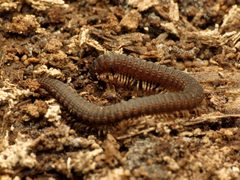
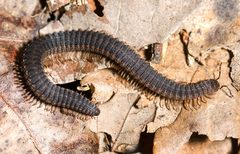
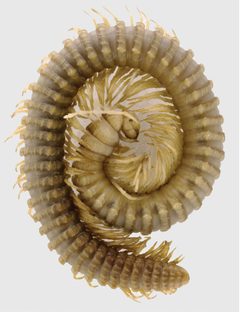
Callipodida is an order of millipedes comprising approximately 130 across three extant suborders and seven . Members are characterized by elongated bodies with 40–60 segments, reaching up to 100 mm in length, and often display distinctive crests or ridges. The order exhibits a disjunct distribution across the Northern Hemisphere, with in North America, Europe, western Asia, southern China, and Southeast Asia. Sexual maturity is achieved through teloanamorphosis, with males possessing a single pair of derived from the seventh leg pair.
Pronunciation
How to pronounce Callipodida: /kæˌlɪˈpɒdɪdə/
These audio files are automatically generated. While they are not always 100% accurate, they are a good starting point.
Identification
Distinguished from other orders by the combination of: (1) single pair of on the 7th body segment in males (concealed in a pouch when not in use), (2) presence of a mid-line groove, and (3) often prominent longitudinal crests or ridges on the tergites. The gonopod structure is complex and -specific, serving as the primary diagnostic character for species identification. From the related order Chordeumatida, Callipodida differs in gonopod origin (8th alone in Chordeumatida versus coxa plus telopodal articles in Callipodida) and presence of a cannula.
Images
Habitat
include caves, forest litter, and rocky surface environments. Many are troglophilic or troglobitic, particularly in the Paracortinidae and Sinocallipodidae. Some species occupy epigean habitats under rocks or in soil. Cave-dwelling species may exhibit troglomorphic traits including reduced and enlarged Tömösváry organs.
Distribution
Disjunct distribution across the Northern Hemisphere: North America, Europe (including Mediterranean coastal regions), western Asia, southern China, and Southeast Asia. The order is absent from South America, Australia, and most of Africa (except Morocco, where Cyphocallipus africanus represents the only known native African ). Southeast Asian fauna is particularly diverse, with three present.
Life Cycle
Development proceeds through anamorphosis with post-embryonic stadia separated by . In Apfelbeckia insculpta, ten stadia occur after hatching, with each molt adding podous and apodous pleurotergites, leg-pairs, and ocelli. Adulthood is achieved through teloanamorphosis (terminal anamorphosis), where the ninth and final molt results in sexual maturity. becomes apparent from stadium VIII onward in some .
Behavior
Males possess complex structures used in copulation; secondary sexual characters include modified legs with setose brushes and coxal processes. Female-biased sexual size dimorphism has been documented, with females generally larger and males showing enhanced traits associated with mobility and copulation. Some cave-dwelling exhibit behavioral adaptations to subterranean environments.
Human Relevance
Subject of taxonomic research due to complex and phylogenetic significance. Some serve as indicators for cave health and biogeographic studies. The 99-million-year-old fossil Burmanopetalum inexpectatum from Burmese amber provides important evidence for evolution and has been used to calibrate .
Similar Taxa
- ChordeumatidaBoth orders have on the 8th leg pair, but differ in gonopod development (8th alone versus coxa plus telopodal articles) and presence/absence of cannula.
- PolydesmidaShares presence of cannula and origin from plus telopodal articles, but differs in body form (Polydesmida typically flattened, not crested) and gonopod position.
More Details
Fossil record
The extinct suborder Burmanopetalidea was erected in 2019 to accommodate Burmanopetalum inexpectatum, a 99-million-year-old specimen from Burmese amber. This fossil, only 8.2 mm long, is the smallest known member of the order and indicates Callipodida originated at least 100 million years ago.
Phylogenetic significance
The Sinocallipus (suborder Sinocallipodidea) is considered the most primitive callipodidan and sister group to all other extant callipodans. The order is hypothesized to belong to an '8th clade' comprising seven orders.
Taxonomic diversity
The order contains three extant suborders: Callipodidea, Schizopetalidea, and Sinocallipodidea; plus one extinct suborder Burmanopetalidea. Seven are recognized: Callipodidae, Abacionidae, Caspiopetalidae, Dorypetalidae, Paracortinidae, Schizopetalidae, Sinocallipodidae, and the recently elevated Cyphocallipodidae.
Sources and further reading
- BugGuide
- Wikipedia
- GBIF taxonomy match
- iNaturalist taxon
- NCBI Taxonomy
- Dwarfs under dinosaur legs: 99-million-year-old millipede discovered in Burmese amber | Blog
- A revision of the millipede family Paracortinidae (Diplopoda, Callipodida)
- An annotated world catalogue of the millipede order Callipodida (Arthropoda: Diplopoda)
- Anamorphic development of Apfelbeckia insculpta (L. Koch, 1867) (Diplopoda: Callipodida: Schizopetalidae)
- A second species in the millipede suborder Sinocallipodidea Shear, 2000 (Diplopoda: Callipodida)
- Cyphocallipus africanus sp. nov.: first native callipodid millipede from continental Africa (Diplopoda, Callipodida)
- Sexual dimorphism in Apfelbeckia insculpta (L. Koch, 1867) (Myriapoda: Diplopoda: Callipodida)
- First record of the troglophile millipede Lusitanipus alternans (Verhoeff, 1893) on surface habitats (Callipodida, Dorypetalidae)
- The first troglomorphic species of the millipede genus Paracortina Wang & Zhang, 1993 from south Yunnan, China (Diplopoda: Callipodida: Paracortinidae)
- A new green-coloured Lusitanipus Mauriès, 1978 from the Iberian Peninsula (Diplopoda: Callipodida: Dorypetalidae)
- Occurrence of the milliped Sinocallipus simplipodicus Zhang, 1993 in Laos, with reviews of the Southeast Asian and global callipodidan faunas, and remarks on the phylogenetic position of the order (Callipodida: Sinocallipodidea: Sinocallipodidae)
- A new species of Paracortina from a Vietnamese cave, with remarkable secondary sexual characters in males (Callipodida, Paracortinidae).