
Geophilus vittatus
Rafinesque, 1820
diamondback soil centipede
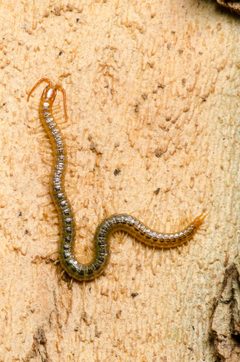
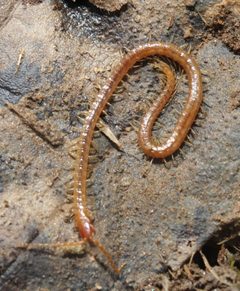
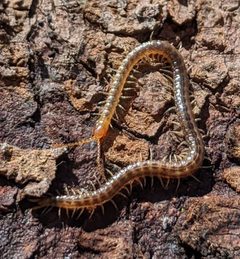
Geophilus vittatus, commonly known as the diamondback soil , is a widespread soil-dwelling centipede in North America. It is named for the distinctive dark band of diamond-shaped markings across its back. The reaches up to 52 mm in length and possesses 49–53 leg pairs in females and 49–51 in males. It is one of the most frequently observed soil centipedes in its range, with over 950 documented observations.
Pronunciation
How to pronounce Geophilus vittatus: /dʒiːˈɒfɪləs vɪˈteɪtəs/
These audio files are automatically generated. While they are not always 100% accurate, they are a good starting point.
Identification
Distinguished from similar Geophilus by the dark band of diamond-shaped markings across the surface. Females have 49–53 leg pairs, males 49–51. Lacks consolidated carpophagus structures. Body length up to 52 mm, averaging 25–40 mm. Color ranges from brown- to orange-yellow.
Images
Habitat
Soil-dwelling; occupies terrestrial in North America. Specific microhabitat preferences (depth, moisture, substrate type) not documented in available sources.
Distribution
Widespread in North America; present throughout the United States. Specific range boundaries and densities not detailed in available sources.
Ecological Role
Soil macrofauna contributing to decomposition and nutrient cycling in terrestrial . Specific ecological functions not quantified in available sources.
Similar Taxa
- Geophilus hadesiBoth are Geophilus , but G. hadesi is exclusively cave-dwelling, found at depths up to 1,100 m, and lacks the diamondback pattern of G. vittatus. G. hadesi also shows extreme troglomorphic adaptations (elongated , trunk segments, leg claws) absent in G. vittatus.
- Geophilus persephonesAnother exclusively cave-dwelling Geophilus with troglomorphic adaptations, paired taxonomically with G. hadesi; distinguished from G. vittatus by restriction and lack of surface-dwelling .
Sources and further reading
- BugGuide
- GBIF taxonomy match
- iNaturalist taxon
- NCBI Taxonomy
- Catalogue of Life
- Forgotten Foto Friday: Centruroides vittatus | Beetles In The Bush
- Rare frog rediscovered after 130 years | Blog
- conservation | Blog - Part 18
- A face only a mother could love | Beetles In The Bush
- A decade of ZooKeys: Publishing and communicating knowledge & love for zoology | Blog
- soil science | Blog