
Anabolia
Stephens, 1837
Species Guides
2- Anabolia bimaculata
- Anabolia consocia(northern caddisfly)
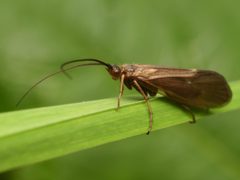
Anabolia is a of northern caddisflies in the Limnephilidae, containing approximately 18 described . Species within this genus inhabit both temporary and permanent aquatic environments, with some species adapted to fluctuating water levels. Larvae exhibit rapid growth rates and extended hatching periods. of some species use for mate attraction.
Pronunciation
How to pronounce Anabolia: /ˌænəˈboʊliə/
These audio files are automatically generated. While they are not always 100% accurate, they are a good starting point.
Identification
Larvae can be distinguished from other limnephilid by morphological features of the capsule, thoracic segments, and abdominal gills; specific diagnostic characters vary by . are medium-sized caddisflies with typical limnephilid wing venation. Species-level identification requires examination of genitalia and other detailed morphological features.
Images
Habitat
Aquatic environments including temporary pools and permanent ponds. Some inhabit areas with fluctuating water levels, with adaptations allowing survival in both conditions.
Distribution
Northern regions including Europe (Denmark, Norway, Sweden) and Asia (China: Gansu Province, Qinghai Province). Distribution centered in temperate to cool regions.
Seasonality
varies by : Anabolia bimaculata emerges through July; Anabolia furcata emergence period determined by laboratory and field studies; emergence timing adapted to avoid high water temperatures.
Life Cycle
laid in autumn; larval hatching extends from November to April in some . Larvae undergo . Rapid larval growth rates observed. emerge in summer months.
Behavior
Larvae of temporary-pool remain in masses until submerged by rising water in spring. Larval serves to maximize food resource use and reduce risk. use extractable for mate attraction.
Similar Taxa
- LimnephilusBoth are limnephilid with similar ; Anabolia typically show faster larval growth rates and different (autumn -laying vs. variable in Limnephilus)
- NemotauliusCo-occurs in similar ; Nemotaulius hostilis inhabits permanent pools and shows reproductive , while Anabolia may inhabit temporary pools with different oviposition timing
More Details
Pheromone biology
Anabolia bimaculata was the first in the demonstrated to use for mate attraction, confirming that communication is widespread in Trichoptera.
Research significance
COI has been used to associate life stages in Anabolia appendix, facilitating description of previously unknown larval and pupal .
Sources and further reading
- BugGuide
- Wikipedia
- GBIF taxonomy match
- iNaturalist taxon
- NCBI Taxonomy
- Catalogue of Life
- Remarks on The Life History of Anabolia Furcata Brauer (Trichoptera)
- The larva and pupa of Anabolia appendix (Ulmer 1905) (Trichoptera: Limnephilidae) from China
- Demonstration of Sex Pheromones in <i>Anabolia Bimaculata, Hydatophylax Argus,</i> and <i>Nemotaulius Hostilis</i> (Trichoptera: Limnephilidae)
- The life histories of Limnephilus externus Hagen, Anabolia bimaculata (Walker), and Nemotaulius hostilis (Hagen) (Trichoptera, Limnephilidae) in a pond in southern Alberta, Canada