
Dicosmoecus gilvipes
(Hagen, 1875)
October Caddis, Autumn Caddis, Giant Orange Sedge
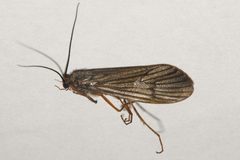
Dicosmoecus gilvipes is a large limnephilid caddisfly native to western North America, commonly known as the October Caddis due to its autumn . The is notable for its synchronous emergence pattern, large larval size (up to 40 mm in final instar), and distinctive case-building that changes dramatically across larval development. Larvae are scraper-grazers on periphyton and serve as an important food source for fish. The species has been widely used in ecological and thermal physiology research and is frequently imitated by fly-fishing anglers.
Pronunciation
How to pronounce Dicosmoecus gilvipes: //daɪˈkɒzmoʊˌiːkəs ˈɡɪlvaɪˌpiːz//
These audio files are automatically generated. While they are not always 100% accurate, they are a good starting point.
Identification
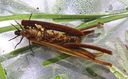
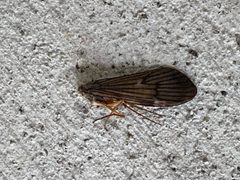
are large, robust with orange-brown coloration. Larvae can be distinguished by their case construction, which changes predictably through instars: early instars use overlapping twigs and needles; instar III incorporates pebbles; instar IV uses coarse sand anteriorly with organic material posteriorly; and the fifth instar case is constructed entirely of mineral material (gravel and stones). Final instar larvae reach 30-40 mm in length. Larvae possess dense setae on the and surfaces of the , with shorter setae on the middle inner .
Images
Habitat
Found in and near streams at mid-elevations across western North America. Larvae occupy different microhabitats seasonally: early instars live on stream edges where cases of leaves and twigs provide buoyancy during high flows; later instars move to deeper water and construct heavier mineral cases. Fifth instars attach cases to the underside of boulders and become in mid-summer, remaining inactive until autumn . studied in California span three eco-regions—mountain, valley, and coastal—with distinct thermal regimes.
Distribution
Western North America from northern California and Colorado north to British Columbia, and east to Nevada, Idaho, Montana, and Alberta. Present in the Nearctic and eastern Palaearctic regions. California show low between mountain, valley, and coastal regions due to short lifespan and limited .
Seasonality
with one per year. emerge and fly in autumn (September-October), giving rise to the "October Caddis." masses are deposited on leaves above streams or on Carex sedges in autumn. Larval development proceeds through five instars from early spring through summer; fifth instars enter dormancy in mid-summer and pupate in autumn.
Diet
Larvae are scraper-grazers that feed on periphyton attached to submerged rocks. Documented food items include diatoms (Synedra ulna, Achnanthes lanceolata) and filamentous (Stigeoclonium tenue, Ulothrix spp., Klebsormidium fluitans), with occasional detritus.
Life Cycle
Five larval instars (I-V) within a single . Instar I appears in early spring and colonizes streams after flood scouring events. Instar II continues use of organic case materials. Instar III begins incorporation of pebbles. Instar IV occurs by late April, using coarse sand anteriorly and organic materials posteriorly. Fifth instar reaches maximum size (30-40 mm) by late summer, constructs entirely mineral cases, attaches to boulder undersides, and enters dormancy until in autumn. live approximately two weeks.
Behavior
Males fly more frequently than females during the mate attraction period, while females limit to enhance trail detection by males. Copulation lasts up to 16 hours, with pairs remaining together throughout the attraction period to ensure single-male mating. Males exhibit governing flight periodicity; females do not. Larvae can travel up to 25 meters per day. Larval negatively affects densities of competing grazers. Larvae alter case construction materials seasonally to match microhabitat needs: buoyant organic materials for edge early in development, heavy mineral materials for deeper water and later.
Ecological Role
Important scraper-grazer in stream , controlling periphyton . Serves as significant prey item for salmonid fish and other aquatic . Competitive interactions with other grazers documented; high densities suppress grazer . Integral element of western North American river and a model organism for benthic macroinvertebrate ecological studies.
Human Relevance
Highly valued by fly-fishing anglers, with patterns frequently imitated. Widely used as a model organism in laboratory and field studies of trophic , , and thermal physiology. Sensitive to recreational disturbance, with showing reduced densities in areas of high human use.
Sources and further reading
- BugGuide
- Wikipedia
- GBIF taxonomy match
- iNaturalist taxon
- NCBI Taxonomy
- Catalogue of Life
- Meloidae Holdings | Entomology Research Museum
- Behavioral Changes in the Herbivorous Caddisfly Dicosmoecus gilvipes (Limnephilidae)
- Effects of Recreational Activities on the Distribution of Dicosmoecus gilvipes in a Mountain Stream
- Mild temperatures differentiate while extreme temperatures unify gene expression profiles among populations of Dicosmoecus gilvipes in California
- <p class="HeadingRunIn"><strong>The biology of the limnephilid caddisfly <em>Dicosmoecus gilvipes</em> (Hagen) in Northern California and Oregon (USA) Streams</strong></p>