
Dicosmoecus
McLachlan, 1875
October Caddisflies
Species Guides
3- Dicosmoecus atripes(northern caddisfly)
- Dicosmoecus gilvipes(October Caddis)
- Dicosmoecus pallicornis
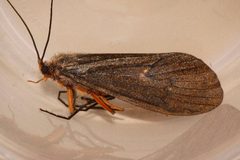
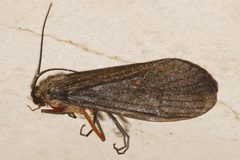
Dicosmoecus is a of in the Limnephilidae, commonly known as October Caddisflies. The genus contains approximately six described distributed across western North America, from California and Oregon through British Columbia to the Rocky Mountains. Species such as D. gilvipes and D. atripes are among the most intensively studied North American caddisflies due to their large larval size, synchronous autumn , and importance in freshwater research and fly-fishing culture.
Pronunciation
How to pronounce Dicosmoecus: //daɪˈkɒs.moʊ.iː.kəs//
These audio files are automatically generated. While they are not always 100% accurate, they are a good starting point.
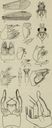
Identification
emerge in autumn (September-October), giving the "October Caddis." Larvae are notably large among North American , with fully grown fifth instars reaching substantial size. Case construction changes with instar: early instars build cases of organic material and detritus, third and fourth instars incorporate pebbles, and fifth instars construct cases entirely of mineral material. Final instar cases are attached to the underside of boulders in mid-summer.
Images
Habitat
Freshwater streams across diverse eco-regions including mountain, valley, and coastal streams. Larvae occur in pools more frequently than riffles. Early instars inhabit stream margins; third and later instars occupy midstream reaches. Fifth instars attach cases to undersides of boulders and enter dormancy until autumn .
Distribution
Western North America: California, Oregon, Washington, British Columbia, and the Rocky Mountains of Alberta, Canada. show genetic separation due to limited , with distinct eco-regional variants in California (mountain, valley, coastal).
Seasonality
and oviposition occur from August to mid-October. Fifth instar larvae become in mid-summer, resuming activity for in autumn. D. atripes in Alberta has a two-year with as first instars and again as dormant fifth instars.
Diet
Larvae are predominantly scraper-grazers. Early instars consume a significantly greater proportion of diatoms compared to later instars. The diet shifts from diatom-dominated in early instars to broader grazing in third and later instars.
Life Cycle
Most are (one-year cycle), though D. atripes in the Rocky Mountains has a two-year cycle. are laid at bases of Carex sedges. Larvae pass through five instars with case material changing at each stage. Fifth instar is terminal; larvae attach cases to boulders and become before pupating in autumn. are short-lived, approximately two weeks.
Behavior
Larvae can travel up to 25 meters per day. Fifth instars attach cases to substrate and enter dormancy until . females use to attract males, with peak male response in the first hour after sunset. Males and females fly during mate attraction but generally not at other times; males exhibit circadian rhythms. Larval negatively affects densities of competing grazers.
Ecological Role
herbivorous grazer in many western North American streams. Larval feeding activity influences benthic structure through competition with other grazers. Integral element of California river and important food source for fish. Frequently used as a model organism for ecological studies of and benthic macroinvertebrates.
Human Relevance
Important to fly-fishing anglers; and larvae are frequently imitated with artificial flies. Sensitive to recreational disturbance, with significantly reduced densities in areas of high human activity. Widely used in laboratory and field studies of trophic , thermal physiology, and .
Similar Taxa
- Other LimnephilidaeDicosmoecus distinguished by large larval size, synchronous autumn , and characteristic case construction sequence changing from organic to mineral materials. Other limnephilids often have different emergence timing and case materials.
- Other autumn-emerging caddisfliesOctober are specifically associated with the Dicosmoecus in western North America; other autumn caddisflies in the region belong to different or have different larval morphologies.
More Details
Thermal Physiology
of D. gilvipes show locally adapted patterns under mild temperature conditions, with distinct responses in mountain, valley, and coastal populations. However, extreme heat stress produces similar (canalized) responses across all populations, indicating conserved thermal stress mechanisms despite local to typical conditions.
Research Significance
Among the most intensively studied North American aquatic insects due to large size facilitating experimental manipulation, synchronous enabling studies, and ecological dominance in many stream systems.
Sources and further reading
- BugGuide
- Wikipedia
- GBIF taxonomy match
- iNaturalist taxon
- NCBI Taxonomy
- Catalogue of Life
- Behavioral Changes in the Herbivorous Caddisfly Dicosmoecus gilvipes (Limnephilidae)
- Effects of Recreational Activities on the Distribution of Dicosmoecus gilvipes in a Mountain Stream
- Mild temperatures differentiate while extreme temperatures unify gene expression profiles among populations of Dicosmoecus gilvipes in California
- The life history of Dicosmoecus atripes (Hagen) (Limnephilidae: Trichoptera) in a Rocky Mountain stream of Alberta, Canada
- <p class="HeadingRunIn"><strong>The biology of the limnephilid caddisfly <em>Dicosmoecus gilvipes</em> (Hagen) in Northern California and Oregon (USA) Streams</strong></p>