
Molannidae
Wallengren, 1891
Hood Casemaker Caddisflies
Genus Guides
1- Molanna(hood casemakers)
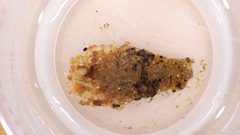
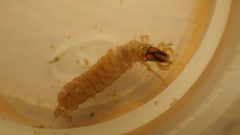
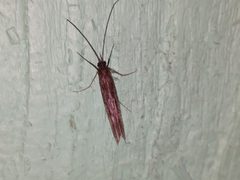
is a small of caddisflies (Trichoptera) containing approximately 40 described across three : Molanna, Molannodes, and Indomolannodes. The family occurs in the Holarctic and Oriental biogeographic regions. are commonly known as "hood casemakers" and have a distinctive appearance in repose, resembling short branch segments. Larvae construct portable cases and inhabit lentic and slow lotic environments, primarily on sandy substrates.
Pronunciation
How to pronounce Molannidae: /moʊˈlænɪdiː/
These audio files are automatically generated. While they are not always 100% accurate, they are a good starting point.
Identification
are recognizable by their distinctive resting posture, appearing like short branch segments. Male genitalia provide -level diagnostic characters, including features of superior appendages (subtriangular in some species), mesal appendages with slender thorns, and inferior appendages with inner processes. Antennal show species-specific , particularly the sensory fields on ventrolateral surfaces of basal flagellomeres and the structure of mushroom-like pseudoplacoids.
Images
Habitat
occur near lakes and running waters. Larvae inhabit sandy substrates in lakes and slower currents of streams, with some found in the profundal zone at depths up to 20 m. In lake margin , larvae occupy shallow (<10 cm) sand-bottomed areas with macrophyte densities ranging from 86 to 452 stems/m².
Distribution
Holarctic and Oriental biogeographic regions. Documented from North America (Canada, adjacent United States, including Vermont), Europe (Denmark, Norway, Sweden), and Asia (China: Sichuan Province at 2299-2377 m elevation, Yunnan Province; Oriental region generally).
Diet
Larvae consume amorphous detritus, plant debris, diatoms, and filamentous . , cladocerans, and other microscopic aquatic animals are also consumed.
Behavior
Larvae exhibit case-building and shift their bodies and cases forward across surface sediments while foraging, moving up to 4 times per minute and traveling as much as 2.5 m per hour. Foraging movements increase with water temperature and peak during midafternoon hours. Larvae forage most actively during daylight and do not selectively use macrophyte beds as refugia from . of at least some exhibit swarming or courtship dances near water where females are located.
Similar Taxa
- LeptoceridaeBoth belong to the superfamily Leptoceroidea and share elongated body forms; are distinguished by their hood-like wing posture and branch-segment appearance at rest.
Sources and further reading
- BugGuide
- Wikipedia
- GBIF taxonomy match
- iNaturalist taxon
- NCBI Taxonomy
- Catalogue of Life
- Demonstration of Female Sex Pheromones and Adult Behaviour in Molanna angustata (Trichoptera: Molannidae)
- REVISION DES TRICHOPTèRES CANADIENS : III. Les Hyalopsychidae, Psychomyiidae, Goeridae, Brachycentridae, Sericostomatidae, Helicopsychidae, Beraeidae, Odontoceridae, Calamoceratidae et Molannidae
- New species of the genus Molanna Curtis, 1834 (Trichoptera, Molannidae) in China inferred from morphology and DNA barcodes
- Habitats and Foraging Movements of Larvae of Molanna uniophila Vorhies (Trichoptera: Molannidae) in Pratt Lake, Michigan, USA
- Life History and Case-building Behavior of Molanna Tryphena Betten (Trichoptera: Molannidae) in Two East Texas Spring-fed Streams
- Life History and Case Building Behavior of <I>Molanna tryphena</I> (Trichoptera: Molannidae) in Two East Texas Spring-Fed Streams
- <p class="HeadingRunIn"><strong>Structure of the antennal sensilla in the genera <em>Molanna</em> and <em>Molannodes </em>(Trichoptera, Molannidae)</strong></p>