
Oecetis
McLachlan, 1877
long-horned caddisflies
Species Guides
3- Oecetis cinerascens(Ashy Long-horned Caddisfly)
- Oecetis inconspicua(Inconspicuous Long-horned Caddisfly)
- Oecetis osteni(long-horned caddisfly)
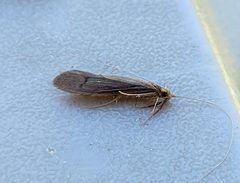
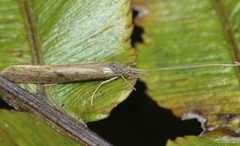
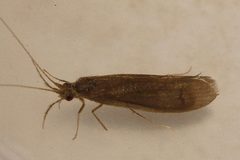
Oecetis is a of long-horned caddisflies in the Leptoceridae, containing over 500 described worldwide. are distinguished by exceptionally long maxillary palps and an unbranched forewing M . Larvae inhabit freshwater environments including lakes, streams, and rivers with sandy substrates. The genus is among the largest and most widely distributed caddisfly genera, occurring in all faunal regions.
Pronunciation
How to pronounce Oecetis: /ˈiːsɛtɪs/
These audio files are automatically generated. While they are not always 100% accurate, they are a good starting point.
Identification
Distinguished from other Leptoceridae by the combination of exceptionally long maxillary palps and unbranched forewing M . The Oecetis tripunctata group is characterized by a stepwise forewing anastomosis cross-vein pattern, broad to segment X, and simple elongated medially separated . Separation from similar requires examination of male genitalia, particularly the profile of gonopods and lateral profile of the phallic organ.
Images
Habitat
Larvae occur in freshwater including lakes, streams, rivers, and canals. Neotropical are frequently associated with sandy substrates and slow-running water. are abundant along rivers and lakes.
Distribution
Worldwide distribution across all faunal regions: Palaearctic, Oriental, Australasian, Afrotropical, and Neotropical. Specific records include: Palaearctic (Austria, Bulgaria, France, Germany, Greece, Portugal, Russia, Syria); Oriental (China, India, Indonesia, Laos, Malaysia, Nepal, Philippines, Sri Lanka, Taiwan, Thailand, Vietnam); Australasian (Papua New Guinea, West Papua/Batanta Island); Afrotropical (mainland Africa, Madagascar, Ghana); Neotropical (widespread).
Life Cycle
Larval stages develop in freshwater environments. Specific details on , pupal, and longevity not documented in sources.
Behavior
are frequently abundant along water bodies and are strongly attracted to light. Specimens are commonly collected using or ultraviolet light traps.
Ecological Role
Frequently abundant in aquatic worldwide. As a large, globally distributed , larvae contribute to freshwater benthic and likely participate in detrital .
Similar Taxa
- Other Leptoceridae generaSimilar elongated and body form; distinguished by Oecetis-specific combination of long maxillary palps and unbranched forewing M
- CeracleaShares Leptoceridae; separation requires examination of wing venation and palp structure
More Details
Species diversity
One of the largest caddisfly with over 534 valid described globally. Recent taxonomic work has described numerous new species from the Neotropical (14 species), Oriental (14 species), Australasian (2 species), and Afrotropical (10+ species) regions.
Taxonomic complexity
The Oecetis tripunctata group has undergone significant revision; the name O. tripunctata sensu stricto is now restricted to the Palaearctic Region, with many former records reassigned to new species.
Sources and further reading
- BugGuide
- Wikipedia
- GBIF taxonomy match
- iNaturalist taxon
- NCBI Taxonomy
- Catalogue of Life
- Contribution to the taxonomy of the Oecetis (Oecetis) tripunctata (Fabricius, 1793) species group (Trichoptera: Leptoceridae)
- Distribution and Variation ofOecetis parva(Trichoptera: Leptoceridae)
- Supplemental Information 1: New species of Oecetis distribution for Google Earth.
- Figure 16: Distribution of the 14 new species of Oecetis based on the specimens presented on material examined sections.
- A new species of Oecetis McLachlan, 1877 (Trichoptera, Leptoceridae) and new distributional records of Trichoptera in the eastern Amazon.