Hydropsyche occidentalis
Banks, 1900
Hydropsyche occidentalis is a filter-feeding caddisfly in the Hydropsychidae, found in lotic (flowing water) streams of North America. It constructs fixed capture nets to filter organic particles from the water column, playing a significant role in stream function. The species has been studied for its bioenergetics and contribution to controlling organic transport in streams, where it can comprise a substantial portion of in suitable .
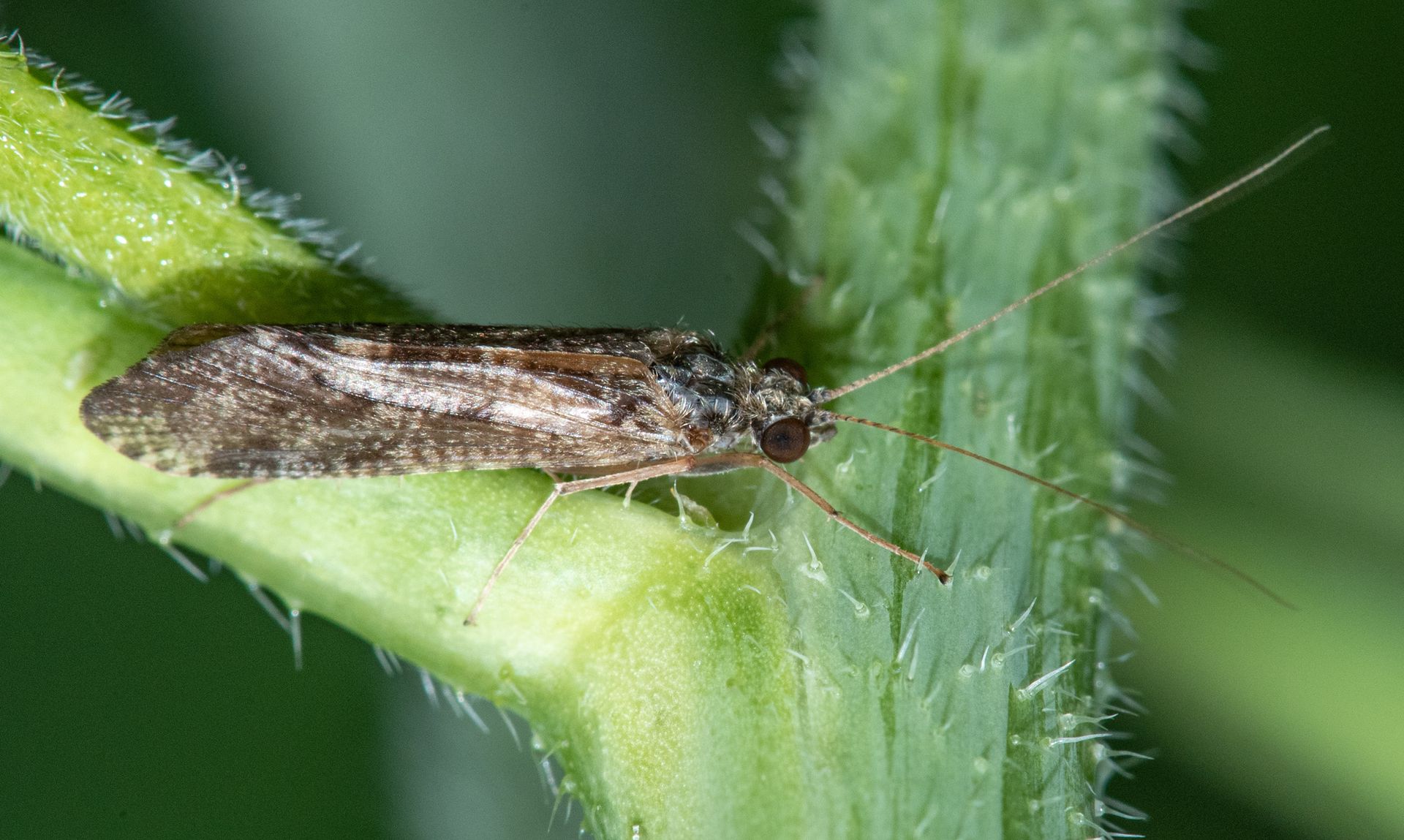
Images
Habitat
Lotic (flowing water) streams, particularly in riffle where current facilitates filter-feeding. Documented from Deep Creek, Idaho, where it occurred at station 2 with mean of 2.45 g DW/m² and of 1786 individuals/m².
Distribution
North America; Nearctic region. GBIF records confirm presence in North America.
Diet
Filter-feeding on suspended organic particles in stream water, including diatoms and other seston. Mean ingestion rates measured at 29.2–31.3 mg DW/mg DW/h for diatoms in laboratory experiments; lower rates observed when green concentrations were high.
Behavior
Constructs fixed capture nets to filter particles from flowing water. Filter-feeding activity removes approximately 1% of seston flowing over the substrate daily. Digestion (gut-clearance) time ranges from 1.54 to 2.63 hours.
Ecological Role
Important filter-feeder in stream , processing suspended organic material and directing energy to higher . Serves as prey for insects and fish. Net growth of 69.6% indicates efficient conversion of ingested material to . In Deep Creek, Idaho, comprised 44% of total standing crop biomass during months of presence.
Similar Taxa
- Simulium spp.Co-occurring filter-feeding insect in similar lotic ; both process suspended organic material but differ in bioenergetic parameters (Simulium has faster gut-clearance time of 0.33–1.25 hours vs. 1.54–2.63 hours for Hydropsyche, and lower net growth of 49.5% vs. 69.6%).
More Details
Bioenergetic Parameters
Respiration rate measured at approximately 2.3 μl O₂/mg DW/h at 20°C for water >62% O₂ saturation. Mean energy budget (J/mg/h): ingestion 0.393, respiration 0.042, growth 0.100, assimilation 0.192. Growth rates under natural conditions: 3.6–4.4 mg DW/mg DW/h.
Sources and further reading
- BugGuide
- GBIF taxonomy match
- iNaturalist taxon
- NCBI Taxonomy
- Bumble Bees: Feeling Impact of Climate Change | Bug Squad
- Probing the Molecular Interactions Between Western Flower Thrips and the Tomato Spotted Wilt Virus | Bug Squad
- Flabellate Grasshopper
- Ticks Can Do More Than 'Tick You Off' | Bug Squad
- Good News for the Western Bumble Bee, Bombus occidentalis
- A sting to kill a cow? Red velvet ant, a.k.a. cow killer, Dasymutilla occidentalis — Bug of the Week
- Bioenergetics of Lotic Filter‐Feeding Insects Simulium SPP. (Diptera) and Hydropsyche Occidentalis (Trichoptera) and their Function in Controlling Organic Transport in Streams