
Simulium
Latreille, 1802
black flies, buffalo gnats, turkey gnats
Species Guides
10- Simulium annulus(Ringed Black Fly)
- Simulium bivittatum(Two Striped Black Fly)
- Simulium clarum(black fly)
- Simulium decorum(Decorous Black Fly)
- Simulium donovani
- Simulium fibrinflatum(Inflated Gnat)
- Simulium longithallum(black fly)
- Simulium trivittatum(black fly)
- Simulium tuberosum(Twinn's black fly)
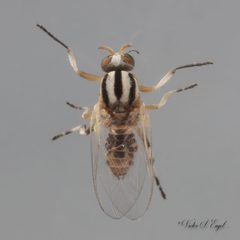
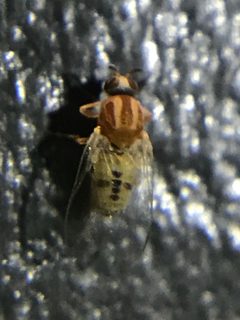
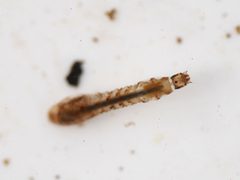
is a large of black flies in the Simuliidae, containing nearly 2,000 described across 38 subgenera. females are obligate blood-feeders that use blade-like to slice skin and lap pooled blood, while males feed on nectar. The genus includes significant , most notably species that transmit Onchocerca volvulus, the causing human (river blindness). Larval stages are strictly aquatic, inhabiting fast-flowing streams and rivers where they filter-feed using specialized cephalic fans.
Pronunciation
How to pronounce Simulium: /sɪˈmjuːliəm/
These audio files are automatically generated. While they are not always 100% accurate, they are a good starting point.
Identification
Distinguished from other Diptera by the combination of: humpbacked , short 11-segmented , broad wings with characteristic venation including a thickened costal margin and reduced fork of radial , and aquatic larval . Separated from other simuliid (Prosimulium, Metacnephia) by details of genitalia, larval fan structure, and pupal gill . Females of pest often identified to species level by thoracic pattern, leg coloration, and microscopic features of the spermatheca and genital fork.
Images
Appearance
Small to medium-sized flies, typically 3–5 mm in body length. Body compact and humpbacked in profile. Coloration generally black, gray, or brown, often with contrasting patterns on or . short with 11 segments. Wings broad, clear or faintly tinted, with reduced venation characteristic of Simuliidae. Legs relatively short and stout. Females possess scissor-like for cutting skin; males have enlarged that meet dorsally on the top of the .
Habitat
Larval stages restricted to flowing water: streams, rivers, and artificial cascades with well-oxygenated, turbulent flow. Larvae attach to submerged stones, vegetation, or debris using silken pads and hooks. found in vicinity of larval waters but females may disperse several kilometers seeking blood . Elevation range extends from lowlands to high mountains, with different occupying distinct altitudinal zones.
Distribution
distribution spanning all zoogeographic regions. Particularly diverse in tropical and temperate zones. Documented from North America, Europe, Asia, Africa, South America, and Australia. Specific records include: Colombia (Amazonas, Antioquia, Boyacá, Caldas, Caquetá, Casanare, Cauca, Cesar, Chocó, Cundinamarca, Guaviare, Huila, Magdalena, Meta, Nariño, Norte de Santander, Putumayo, Quindío, Risaralda, Santander, Tolima, Valle del Cauca, Vaupés), Denmark, Norway, Sweden, Malaysia, Thailand, and Serbia.
Seasonality
Activity period varies by latitude and elevation. Temperate typically active spring through autumn with peak abundance in late spring and early summer. Tropical species may breed year-round. Multiple per year possible where water temperatures permit; development from to completed in 3–4 weeks under favorable conditions. Winter typically passed as larvae in temperate regions.
Diet
females: vertebrate blood (obligate for maturation). Adult males: nectar and other sugary fluids. Larvae: filter-feeders consuming organic particulates, diatoms, and small organisms intercepted from water current by cephalic fans.
Life Cycle
Holometabolous with aquatic , larval, and pupal stages. Eggs laid on vegetation, submerged objects, or water surface; freshly laid eggs release attracting females to oviposit nearby. Larvae hatch and construct silken attachment pads on submerged substrates, anchoring with abdominal hooks. Larvae undergo 7–11 , feeding via paired cephalic fans. Final instar spins silken pupal cocoon with tapered end oriented into current; pupa possesses branching gills protruding from cocoon. emerges in air bubble, floats to surface, and completes wing hardening on emergent substrate. Total development 3–4 weeks, temperature-dependent.
Behavior
females are , , or blood-feeders depending on . Pool feeders that cut skin and lap extravasated blood; saliva contains anticoagulants, , and histamine. Females capable of long-distance : documented exceeding 90 km from larval sources. Swarming observed, with attacks often concentrated on and upper body. Larvae maintain position in current using silk pads and hooks; filter-feed continuously.
Ecological Role
Larvae function as and filter-feeders in lotic , processing organic matter and linking detrital to higher consumers. serve as food for insectivorous birds, bats, and other . Females are significant of mammals and birds, with some acting as for filarial (Onchocerca), protozoan (Leucocytozoon), and potentially . Some species appear to be -specific to wildlife and do not bite humans or livestock.
Human Relevance
Major medical and veterinary importance. Several are principal of Onchocerca volvulus, causative agent of (river blindness), affecting millions in sub-Saharan Africa and Latin America. Bites cause immediate pain, localized tissue damage, and allergic reactions; heavy attack rates can induce blood-loss anemia in livestock. reaction
Similar Taxa
- ProsimuliumAnother simuliid ; generally larger with different wing venation and genitalic structure; larvae often in colder, faster streams
- MetacnephiaSimuliid with reduced number of pupal gill filaments and distinct larval fan
- Culicidae (mosquitoes)Both are blood-feeding Diptera, but mosquitoes possess long for piercing-sucking rather than cutting-lapping mouthparts, and have aquatic larval stages in still water rather than flowing water
- Ceratopogonidae (biting midges)Small biting flies often confused with black flies; possess piercing mouthparts and different wing venation; larvae typically in moist soil or semi-aquatic rather than torrential streams
More Details
Folklore association
colombaschense, the 'Golubatz fly,' features in Serbian folklore as the swarm emanating from the corpse of an ala (demon) in a cave near Golubac. The was a notorious pest in the Banat region during the 18th century; its specific epithet derives from 'Golubac' (Serbian: Golubatz).
Vector potential of newly described species
(Gomphostilbia) maleewongae, described from Thailand in 2016, belongs to a subgenus containing known , suggesting possible medical importance though this remains unconfirmed.
Sources and further reading
- BugGuide
- Wikipedia
- GBIF taxonomy match
- iNaturalist taxon
- NCBI Taxonomy
- Catalogue of Life
- Simulium sp. black fly - Entomology Today
- Simulium sp. black fly - Entomology Today
- Simulium-kalimantanense-larva - Entomology Today
- DNA Analysis Reveals Parasite Diversity in Black Flies
- Bug Eric: Bite of the Black Fly
- New Species of Black Fly Discovered in Thailand