
Simulium bivittatum
Malloch, 1914
Two Striped Black Fly
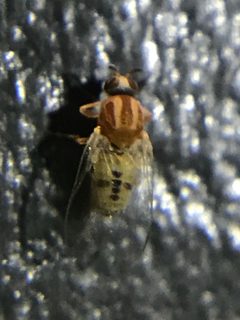
Simulium bivittatum is a of black fly in the Simuliidae, first described by Malloch in 1914. Larvae are aquatic that capture organic particles from flowing water using specialized cephalic fans. females are blood-feeders that require protein for development, while males do not feed on blood.
Pronunciation
How to pronounce Simulium bivittatum: /sɪˈmjuː.li.əm baɪ.vɪˈtæ.təm/
These audio files are automatically generated. While they are not always 100% accurate, they are a good starting point.
Identification
Specific diagnostic features for S. bivittatum are not documented in available sources. As a member of Simulium, are small (approximately 3–4 mm), typically black or dark-colored, with females having relatively small and males having large eyes that meet dorsally at the top of the . Larvae possess paired cephalic fans used for filter feeding and abdominal hooks for anchoring to substrates in flowing water.
Images
Habitat
Larvae inhabit lotic (flowing water) environments, including streams and rivers. They attach to stones or vegetation in the current using silken pads spun on substrate surfaces. The pupal stage occurs within a silken bag oriented with the tapered end upstream and open end downstream.
Diet
Larvae are that capture suspended organic particles from the water column. Research indicates they efficiently capture particles smaller than the pore spaces between filtering structures, with highest capture for particles 0.5–5.7 μm in size. Capture occurs through interception and diffusive deposition mechanisms rather than simple mechanical sieving. females feed on blood; males do not.
Life Cycle
Aquatic stages include , larva, and pupa. Larvae 7–11 times before pupating. The larva spins a silken bag for , with branching gills extending from the pupa. emerge after a few days, rising to the water surface in air bubbles. Total development from egg to adult takes approximately 3–4 weeks, with duration strongly influenced by water temperature. Multiple per year are possible; winter is typically spent as larvae.
Behavior
Larvae spin silken pads on submerged substrates and anchor themselves with abdominal hooks. They deploy cephalic fans to intercept organic particulates from the current. Freshly-laid produce a that attracts females and stimulates oviposition in the vicinity. females are capable of flying long distances (documented up to 90 miles) in search of blood meals.
Human Relevance
females bite humans, using jagged to lacerate skin and feed on pooled blood. Bites can cause painful reactions including fever, headache, nausea, and swollen lymph nodes in sensitive individuals. The is a potential for Leucocytozoon blood that cause leucocytozoonosis in birds.
Similar Taxa
- Simulium (Gomphostilbia) maleewongaeBoth are members of Simulium with similar larval filter-feeding , but S. maleewongae is a Southeast Asian with potential as a , whereas S. bivittatum is a North American species with different vector associations.
- Other Simulium speciesApproximately 40 Simulium occur in Colorado alone; S. bivittatum is distinguished by specific morphological features (not detailed in sources) and may occupy different elevations or geographic regions relative to .
More Details
Filter Feeding Mechanism
Research on S. bivittatum larvae demonstrates that their filtering structures capture particles through mechanisms beyond simple mechanical sieving. Interception and diffusive deposition allow efficient capture of particles smaller than filter pore spaces, with diffusive deposition being the better predictor of capture for 0.5–5.7 μm particles. Particle adhesion to filters likely involves hydrophilic–hydrophobic or ionic interactions.
Sources and further reading
- BugGuide
- GBIF taxonomy match
- iNaturalist taxon
- NCBI Taxonomy
- Simulium sp. black fly - Entomology Today
- Simulium sp. black fly - Entomology Today
- Simulium-kalimantanense-larva - Entomology Today
- DNA Analysis Reveals Parasite Diversity in Black Flies
- Bug Eric: Bite of the Black Fly
- New Species of Black Fly Discovered in Thailand
- Mechanisms of filter feeding in immature Simulium bivittatum Malloch (Diptera: Simuliidae) and Isonychia campestris McDunnough (Ephemeroptera: Oligoneuriidae)