
Prosimulium
Roubaud, 1906
black flies
Species Guides
1- Prosimulium mixtum(Mixed-up Black Fly)
Prosimulium is a of black flies ( Simuliidae) containing at least 110 described . Like other black flies, members of this genus have aquatic larval and pupal stages in flowing water, with females of many species requiring blood meals for development. The genus is distinguished as part of the tribe Prosimuliini and is one of three genera of black flies found in Colorado, USA.
Pronunciation
How to pronounce Prosimulium: /proʊˈsɪmjʊliəm/
These audio files are automatically generated. While they are not always 100% accurate, they are a good starting point.
Identification
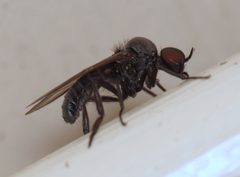
Prosimulium are small black flies, typically 3–4 mm in length. They can be distinguished from other black fly by tribal-level morphological characters associated with Prosimuliini. Males have large that meet at the top of the . Females possess knife-like mouthparts used for cutting skin to obtain blood, rather than the beak-like piercing mouthparts of mosquitoes. Species-level identification requires specialized examination and is not possible from general descriptions.
Images
Habitat
Larvae and pupae develop in fast-flowing streams and rivers, where they attach to stones or vegetation using silken pads. are found in terrestrial environments, often near their aquatic breeding sites, though females may fly considerable distances in search of blood meals. Different occur at different elevations and on different sides of the Continental Divide in Colorado.
Distribution
Records exist from Norway (NO) and Sweden (SE). The occurs in North America, including Colorado where it is one of three black fly genera present. Specific distribution details for individual are not available from provided sources.
Diet
Larvae feed by deploying paired cephalic fans that intercept organic particulates from the water current. males feed on nectar. Females of many require blood meals for proper development, though the majority of black fly species in Colorado feed on birds and other wildlife rather than humans or livestock.
Life Cycle
are laid on vegetation or objects in or on the water, or scattered on the water surface. Larvae hatch and attach to substrates with abdominal hooks, molting 7–11 times. At the end of the larval stage, a silken pupal bag is spun with the tapered rear pointing upstream. Pupae possess branching gills that may extend beyond the bag opening. emerge after several days, rising to the surface in air bubbles. Total development from egg to adult takes roughly 3–4 weeks, heavily influenced by water temperature. Multiple occur per year; winter is typically spent in larval stage.
Behavior
Freshly-laid produce a that attracts other females of the same and stimulates them to lay eggs nearby. Females are capable of flying miles in search of blood meals; records in Canada document exceeding 90 miles from larval development sites.
Ecological Role
Larvae function as filter-feeders in aquatic , processing organic particulates from flowing water. serve as food for various . Some act as pests or for birds, livestock, and humans.
Human Relevance
Some Prosimulium bite humans, causing painful wounds and potential allergic reactions. Bites are inflicted with knife-like mouthparts that slice skin open, rather than piercing. The includes species that can cause severe distress to livestock and poultry, and may carry . Effective insect repellent is recommended in areas where biting species occur.
Similar Taxa
- SimuliumAnother of black flies in Simuliidae; distinguished by tribal affiliation (Simuliini vs. Prosimuliini) and subtle morphological differences not specified in available sources
- MetacnephiaThird of black flies occurring in Colorado alongside Prosimulium; distinguished by tribal-level characters and elevation/distribution patterns
More Details
Species diversity
At least 110 described exist in the , though specific biological details for most remain undocumented in provided sources.
Elevation patterns
In Colorado, different Prosimulium occupy different elevations, with distribution varying between east and west sides of the Continental Divide.