
Arctopsyche grandis
(Banks, 1900)
netspinning caddisfly
Arctopsyche grandis is a of netspinning caddisfly in the Hydropsychidae, found in North America. Larvae construct silk nets to capture food in flowing water and complete their development in approximately one year. The species has been studied in Central Idaho streams where it reaches high densities on rocky substrates.
Pronunciation
How to pronounce Arctopsyche grandis: //ˌɑrktoʊˈsaɪki ˈɡrændɪs//
These audio files are automatically generated. While they are not always 100% accurate, they are a good starting point.
Identification
Larvae can be distinguished from other hydropsychid by their net-spinning and association with lotic . Net dimensions correlate with capsule width, allowing instar determination. require identification; the is part of the diverse Hydropsychidae where morphological separation of similar species often depends on genitalic characters.
Images
Appearance
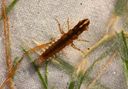
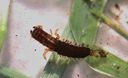
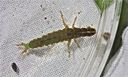
are medium-sized with wings typically held roof-like over the body. Larvae possess a hardened capsule with head capsule widths ranging from 403–2197 μm across instars. Body weight increases from approximately 0.05 mg to 16.23 mg AFDW (ash-free dry weight) from first to fifth instar. Larvae produce silk nets for food capture.
Habitat
Cold, flowing streams with rocky substrates. Larvae attach to planar rock surfaces where they construct capture nets. The occupies lotic freshwater in montane or temperate regions.
Distribution
North America; confirmed present in Central Idaho streams. GBIF records indicate presence across the Nearctic region.
Seasonality
Larvae present year-round with multiple instars coexisting in most months. timing not specified in available sources.
Diet
Larvae feed preferentially on animal prey and diatoms, actively avoiding vascular plant detritus. No dietary differences detected among instars.
Life Cycle
(one-year ) with five larval instars. Three to four instars are typically present simultaneously in most months. Rapid growth occurs during summer, with first and second instars progressing to fourth and fifth instar within 30 days or less. Growth ceases or is minimal during winter months. survival follows a negative exponential curve.
Behavior
Larvae construct and maintain silk capture nets throughout the year. Nets are actively maintained and their dimensions with larval size. Larval can reach high densities (up to 2060 individuals per square meter of rock surface).
Ecological Role
Larval silk nets modify local hydrodynamics and capture organic matter, influencing nutrient cycling in stream . As and grazers on diatoms and animal prey, larvae occupy an intermediate trophic position. High densities suggest substantial contribution to secondary production in suitable .
Similar Taxa
- Other Hydropsychidae speciesMany hydropsychid share net-spinning larval and rocky stream ; identification to typically requires examination of genitalia or detailed larval
More Details
Population dynamics
Maximum larval densities of 547 m⁻² (1977) and 2060 m⁻² (1978) recorded on planar rock surface area in Central Idaho study. followed negative exponential curves with exponents of −0.0078 and −0.0103 in consecutive years.
Growth patterns
Larval growth is generally isometric, with capsule width and weight increasing by a factor of approximately 1.5 between successive instars.
Sources and further reading
- BugGuide
- Wikipedia
- GBIF taxonomy match
- iNaturalist taxon
- NCBI Taxonomy
- Catalogue of Life
- Guest Blog Post: Researchers split the birdcatcher trees (genus Pisonia) into three | Blog
- Bug Eric: Wasp Wednesday: Western Cicada Killer
- Nomenclatural changes in Phymatodes | Beetles In The Bush
- Life history and bionomics of Arctopsyche grandis (Trichoptera) in a Central Idaho stream