
Scolothrips
Hinds, 1902
six-spotted thrips
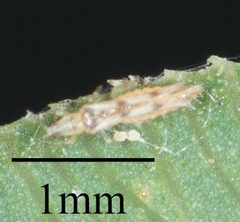
Scolothrips is a of predatory thrips (Thysanoptera: Thripidae) established by Hinds in 1902. within this genus are obligate of spider mites (Tetranychidae) and related mite (Tenuipalpidae). The genus includes economically important species such as S. longicornis and S. sexmaculatus, which have been studied for potential. Some species show apparent specificity, while others feed on multiple mite prey species. Development, , and survival are strongly influenced by environmental factors including temperature and .
Pronunciation
How to pronounce Scolothrips: /ˌskoʊloʊˈθrɪps/
These audio files are automatically generated. While they are not always 100% accurate, they are a good starting point.
Identification
Members of Scolothrips can be distinguished from other Thripinae by a combination of setal characters, though specific diagnostic features vary by . S. ochoa lacks ocellar setae pairs I and II, lacks elongate pronotal midlateral setae, and has antennal segments III–IV and V–VI broadly joined—features that separate it from . S. sexmaculatus has six dark spots on the , giving rise to its . Accurate identification to species level requires examination of chaetotaxy and antennal segmentation.
Images
Habitat
Specific natural data are not available for most Scolothrips . Laboratory rearing studies indicate successful development under controlled conditions: 60–75% relative humidity, ranging from 0:24 to 24:0 L:D, and temperatures between 15°C and 37.5°C. Optimal laboratory conditions for mass production of S. longicornis are 26–30°C with 12:12 L:D photoperiod.
Distribution
recorded from Australia (S. ochoa), United States (S. sexmaculatus), and broader geographic distribution including Norway and Sweden (GBIF records). Specific range data for most are limited.
Diet
Predatory; feeds on spider mites. S. longicornis has been observed feeding on Tetranychus turkestani and Tetranychus urticae. S. ochoa feeds on Raoiella mites (Tenuipalpidae).
Host Associations
- Tetranychus turkestani - preystrawberry spider mite; laboratory confirmed
- Tetranychus urticae - preytwo-spotted spider mite; laboratory confirmed
- Raoiella - prey of flat mites (Tenuipalpidae); S. ochoa only
Life Cycle
Development includes and stages (pre-). In S. longicornis, pre-adult developmental period decreases with increasing temperature until 35°C, then increases. Longevity is temperature-dependent: longest at 15°C, shortest at 37.5°C. Under 12:12 L:D at 25°C, females have extended oviposition periods and longevity compared to other photoperiods.
Behavior
S. ochoa has been described as apparently -specific, though this characterization requires further validation. S. longicornis shows -dependent development and , with 12:12 L:D being most favorable for increase.
Ecological Role
of spider mites and related acariform mites. such as S. longicornis are candidates for programs against agricultural pest mites.
Human Relevance
Studied for mass production and of spider mite pests in agriculture. S. longicornis has been evaluated for commercial rearing with optimal conditions identified (26–30°C, 12:12 L:D , 60–75% RH).
Similar Taxa
- Other Thripinae generaScolothrips is distinguished by predatory habit and associated morphological adaptations; most Thripinae are phytophagous or fungivorous rather than predatory on mites.
- Other predatory thrips genera (e.g., Franklinothrips, Leptothrips)These also contain predatory but differ in chaetotaxy, antennal structure, and prey associations; Scolothrips is specialized on mites rather than thrips or other small arthropods.
More Details
Taxonomic notes
The belongs to Thripinae. S. ochoa exhibits unusual morphological features within Thripinae, including absence of ocellar setae pairs I and II.
Research gaps
Field , natural distribution, and range remain poorly documented for most . Host specificity claims require confirmation through controlled choice experiments.
Sources and further reading
- BugGuide
- GBIF taxonomy match
- iNaturalist taxon
- NCBI Taxonomy
- Catalogue of Life
- Pest Information Guide: Six-Spotted Thrips Scolothrips sexmaculatus (Pergande)
- A new species of predatory Scolothrips (Thysanoptera, Thripidae) feeding on Raoiella mites (Tenuipalpidae) in Australia
- Temperature influences demography and mass production of Scolothrips longicornis fed on Tetranychus turkestani
- Effect of temperature on life history traits of the predatory thrips, Scolothrips takahashii Priesner (Thysanoptera: Thripidae)
- Effects of photoperiod on development and demographic parameters of the predatory thripsScolothrips longicornisfed onTetranychus urticae