
Eupathocera westwoodii
(Templeton, 1841) Benda, Pohl, Nakase, Beutel & Straka, 2022
Eupathocera westwoodii is a of twisted-wing in the order Strepsiptera. These insects are obligate of other insects, with larvae entering through joints or . The species has been documented parasitizing , including the Great Black Wasp (Sphex pensylvanicus). Females are neotenic and remain permanently within host , while males emerge as free-flying that live only a few hours and must mate within that brief window.
Pronunciation
How to pronounce Eupathocera westwoodii: /juːˌpæθoʊˈsɪərə ˌwɛstˈwʊdaɪ/
These audio files are automatically generated. While they are not always 100% accurate, they are a good starting point.
Identification
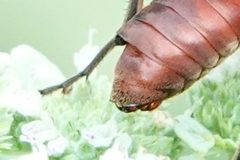
Strepsipteran are typically detected through observation of their rather than direct observation of the parasite itself. Infected may exhibit deformities of abdominal segments, with bullet-like capsules protruding between segments. Male E. westwoodii are extremely small (0.5–5 mm range for the order), with distinctive reduced forewings and fan-shaped hindwings. Females are legless, eyeless, and remain embedded within the host .
Images
Distribution
Documented from Brazil (Rio de Janeiro), Dominican Republic (Santo Domingo), USA (Texas, Montana), and Mexico. Distribution is constrained by that of its .
Host Associations
- Sphex pensylvanicus - Documented ; parasitizes
- Isodontia mexicana - Photographic documentation exists of
Life Cycle
Larvae enter insects through joints or . Female are neotenic and dwell permanently within host . Males eclose and enter a free-flying stage lasting only a few hours, during which they must locate and mate with females. The complete details for this specific remain poorly documented.
Ecological Role
of solitary . -level impacts on have not been quantified.
Human Relevance
Documented as a of the conspicuous Great Black Wasp, making it indirectly observable to naturalists. No direct economic or medical significance established.
Similar Taxa
- Xenos peckiiBoth are strepsipteran of ; X. peckii parasitizes Polistes paper wasps rather than sphecid digger wasps
- Eupathocera auripedis with similar associations; both parasitize sphecid including Isodontia