
Xenos peckii
Brues, 1903
Xenos peckii is a highly specialized endoparasitic insect in the order Strepsiptera, commonly known as twisted-wing parasites. It is an obligate of paper wasps, specifically Polistes fuscatus, with development occurring entirely within the 's abdominal cavity. The exhibits extreme : males are free-flying with reduced wings and unusual containing green- and UV-sensitive photoreceptors, while females are neotenic, lacking wings, legs, and eyes, and remain permanently embedded within the host. Males locate females through a species-specific , (3R,5S,9R,7E,11E)-3,5,9,11-tetramethyl-7,11-tridecadienal, which females actively release by inflating and extruding their through the host's . The species has been documented across temperate North America and possesses unique cellular mechanisms for meiotic spindle formation that have been studied ultrastructurally.
Pronunciation
How to pronounce Xenos peckii: /ˈkse.nos ˈpek.i.aɪ/
These audio files are automatically generated. While they are not always 100% accurate, they are a good starting point.
Identification
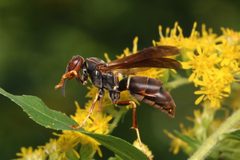
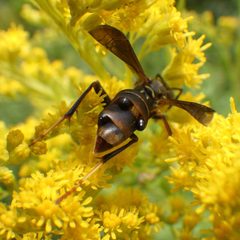
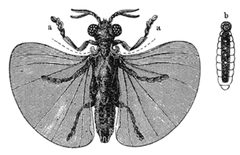
Parasitized (Polistes fuscatus) display a conspicuous asymmetric abdominal bulge where the female Xenos peckii protrudes through the host's . Male pupae may be visible as cylindrical cases protruding from the host . Free-flying males are small (approximately 0.5–5 mm), with reduced forewings modified into club-shaped and large, fan-shaped hindwings. The male bears unusual with a distinctive raspberry-like . Adult females are not free-living; only the white (later darkly pigmented) cephalothorax is externally visible, permanently exserted from the host. Multiple individuals commonly occur in a single host.
Images
Habitat
Associated with nests of the paper wasp Polistes fuscatus in temperate environments. The occupies the abdominal cavity of its and is therefore restricted to the microhabitat provided by living . Collection has occurred from natural wasp nests in field settings.
Distribution
Temperate North America. Documented in northeastern United States, Alabama, California, Indiana, Maryland, Michigan, Ohio, and Texas. Distribution is constrained by the range of its , Polistes fuscatus.
Seasonality
Male occurs seasonally in early July, with daily emergence patterns concentrated in the afternoon. This timing coincides with female receptivity and calling periods.
Host Associations
- Polistes fuscatus - obligate Development occurs entirely within the abdominal cavity of this paper wasp . Multiple Xenos peckii individuals may parasitize a single . Stylopized wasps exhibit reduced and conspicuous abdominal bulging from protruding cephalothoraces.
Life Cycle
Development is entirely endoparasitic within the . Males pupate in cylindrical cases that protrude through host ; upon maturation, males cut the along an ecdysial line with their and push aside the pupal cap to emerge. males live only a few hours and must locate and mate with females during this brief period. Females do not pupate; they remain neotenic within the host, permanently exserting the through the host for mating access. Interphase undergo meiotic maturation beginning 4–5 days after first exsertion, coinciding with cephalothorax darkening. Unfertilized eggs reaching first meiotic metaphase degenerate after 10–14 days. Eggs develop synchronously within each female. After mating, the female fully retracts the cephalothorax and does not remate.
Behavior
Females perform active calling to attract males: they slowly inflate the , extrude it farther outward, and tilt it away from the to release . Males approach calling females with a characteristic swaying pattern and smooth turns. Upon landing on the portion of the host abdomen, males walk backward until their mesothoracic legs contact the female cephalothorax, at which point the legs curl around it and mating initiates. After mating, the female permanently withdraws the cephalothorax and does not mate again. Males use UV vision, possibly to locate the cryptic females within their hosts.
Ecological Role
Obligate that reduces of paper wasp . The represents an extreme example of parasitic lifestyle evolution with complete dependence on a single host species for survival and .
Human Relevance
Subject of scientific research due to unusual visual system, unique meiotic spindle formation mechanisms, and extreme . The has been used to test the concept of xenosurveillance—sampling arthropods to monitor for —though it is not itself a candidate for this application. identification and synthesis have been achieved, enabling field trapping studies.
Similar Taxa
- Other Xenos speciesShare the same and general parasitic lifestyle in Polistes , but differ in host specificity, chemistry, and geographic distribution. Xenos peckii is specifically associated with Polistes fuscatus and possesses the distinctive (3R,5S,9R)-configured .
- Other Strepsiptera families (e.g., Stylopidae, Elenchidae)All Strepsiptera share endoparasitic development and extreme , but differ in associations (other parasitize bees, leafhoppers, or other insects), morphological details of males, and female reproductive structures.
Sources and further reading
- BugGuide
- GBIF taxonomy match
- iNaturalist taxon
- NCBI Taxonomy
- RJ Millena: from Entomology-Focused Kindergartener to Scoring Cover of Journal With Her Research | Bug Squad
- xenosurveillance Archives - Entomology Today
- Study Shows Flies, Cockroaches Do Not Transmit Coronavirus
- Vote for Buglife in My Favourite Voucher Codes charity poll! - Buglife Blog - Buglife
- New findings on life history traits ofXenos peckii(Strepsiptera: Xenidae)
- The unusual eyes ofXenos peckii(Strepsiptera: Xenidae) have green- and UV-sensitive photoreceptors
- Intranuclear membranes and the formation of the first meiotic spindle in Xenos peckii (Acroschismus wheeleri) oocytes.
- Total Synthesis, Stereochemical Assignment, and Field‐Testing of the Sex Pheromone of the Strepsipteran Xenos peckii