
Liposcelis entomophila
(Enderlein, 1907)
booklouse
Liposcelis entomophila is a small commonly known as a booklouse. It is a significant pest of stored grain products, with documented in wheat and other stored foods. The species exhibits in development, with females passing through four nymphal stages and males through three. It has developed notable resistance to phosphine used in grain storage, with factors of 40- to 80-fold reported in Chinese . The species has a broad global distribution spanning six continents.
Pronunciation
How to pronounce Liposcelis entomophila: /ˌlɪpoʊˈsɛlɪs ˌɛntəˈmɒfɪlə/
These audio files are automatically generated. While they are not always 100% accurate, they are a good starting point.
Identification
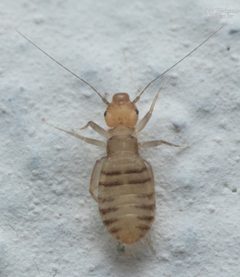
Females develop through four nymphal stages; males through three nymphal stages. are minute, typically around 1 mm in length, with soft bodies and reduced or absent wings. Distinguished from other stored product psocids by bionomic characteristics and distribution patterns; L. decolor, L. paeta, and L. mendax are sympatric in some regions. Molecular or microscopic examination may be required for definitive identification.
Images
Habitat
Stored grain products, particularly wheat in steel storage bins. Laboratory rearing successful on whole wheat flour and yeast (10:1 ratio) at controlled temperature and humidity.
Distribution
Africa, Australia, Caribbean Sea region, Europe and Northern Asia (excluding China), Central America, North America, South America, and Southern Asia. Specific records from Angola, Australia, Azores, Cape Verde Islands, Chile, China, Colombia, Congo, Cuba, Cyprus, Galápagos Islands, Guinea-Bissau, India, Indonesia, Israel, Japan, Korea, Lesser Antilles, Madagascar, Mascarene Islands, Mexico, Mozambique, New Hebrides, Nicaragua, Philippines, Senegal, Singapore, Sri Lanka, Tanzania, Thailand, Togo, Turkey, Vietnam, USA, Yugoslavia, and Zimbabwe.
Diet
Whole wheat flour and yeast in laboratory conditions; associated with stored grain products in field . Specific natural diet components not documented.
Life Cycle
At 30±1°C and 75±3% relative humidity: females complete development in mean 22.3 days through four nymphal stages; males complete development in mean 18.4 days through three nymphal stages. Developmental mortality of 28% observed. Development threshold temperature estimated at 15.7°C with effective accumulated temperature of 460.7 for stages. Development time from to varies from 71.9 days at 20°C to 21.7 days at 35°C at 75% RH. Cannot survive at 17.5°C or below 50% RH.
Human Relevance
Major pest of stored grain in China and other regions; most common and widely distributed in Chinese grain storage systems. Significant economic impact due to phosphine resistance (40- to 80-fold in field ), compromising standard practices for stored product protection. Subject of research and development of alternative control strategies.
Similar Taxa
- Liposcelis decolorSecond most common in Chinese grain storage systems; sympatric with L. entomophila in steel wheat bins
- Liposcelis bostrychophilaCongeneric stored product pest; same culturing regime effective for both , suggesting similar bionomic requirements
- Liposcelis paetaDetected in same Chinese grain storage survey; less common than L. entomophila
- Liposcelis mendaxDetected in same Chinese grain storage survey; less common than L. entomophila
Sources and further reading
- BugGuide
- Wikipedia
- GBIF taxonomy match
- iNaturalist taxon
- NCBI Taxonomy
- Catalogue of Life
- Take a Bug Break--and Bring Along This Book | Bug Squad
- Bohart Museum Open House: Bed Bugs and Cochroaches and Pantry Pests | Bug Squad
- STUDIES ON BIONOMICS OF LIPOSCELIS ENTOMOPHILA (PSOCOPTERA:LIPOSCELIDIDAE) INFESTING STORED PRODUCTS*
- Life cycle of Liposcelis entomophila (Psocoptera: Liposcelididae) and a culturing regime for liposcelids
- Temporospatial Distribution of the Psocids <I>Liposcelis entomophila</I> and <I>L. decolor</I> (Psocoptera: Liposcelididae) in Steel Bins Containing Wheat
- A survey of psocid species infesting stored grain in China and resistance to phosphine in field populations of Liposcelis entomophila (Enderlein) (Psocoptera: Liposcelididae).