
Liposcelis bostrychophila
Badonnel, 1931
House Psocid, booklouse
Liposcelis bostrychophila is a minute, wingless booklouse with near-global distribution, primarily associated with stored products and grain facilities. Most reproduce exclusively through , with females producing approximately 200 over their lifetime. The species has emerged as a significant pest of stored cereals due to its high reproductive rate and documented resistance to chemical control measures. was first documented in 2002 in Hawaii, and a second sexually reproducing strain was later identified in Arizona.
Pronunciation
How to pronounce Liposcelis bostrychophila: //ˌlaɪpoʊˈsiːlɪs bɒˌstrɪkoʊˈfaɪlə//
These audio files are automatically generated. While they are not always 100% accurate, they are a good starting point.
Identification
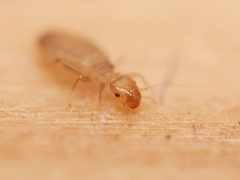
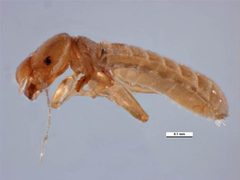
Distinguished from other stored-product psocids by combination of small size (1–2 mm), wingless condition, pale brown coloration, and 15-segmented . The flattened, expanded hind is a key character of the Liposcelis. Most similar in stored products require microscopic examination of antennal segmentation and body proportions for definitive identification.
Images
Appearance
Tiny, pale brown, wingless insect measuring 1–2 mm in length. Body is flattened with a relatively long . short with 15 segments. reduced. Hind leg wide and flattened. possess three segments. widely separated. Coloration ranges from transparent to light brown.
Habitat
Primarily associated with human-modified environments: grain stores, warehouses, food processing factories, and households. Found wherever dry foodstuffs are processed or stored. In natural settings, occurs in ground and woody vegetation in highland areas.
Distribution
distribution, documented from Europe (including Azores: Faial, São Miguel, Terceira), North America (including Hawaii, Arizona), and other regions worldwide. First Hawaiian records confirmed from islands of Hawaii and Maui.
Diet
Feeds on stored dry foodstuffs, particularly cereals and grain products. Has been observed consuming starchy materials including book bindings and glue. In natural , consumes lichens, , and organic detritus. In 2019, identified as a of mosquito in laboratory rearing facilities.
Life Cycle
Females produce approximately 200 . Eggs hatch into nymphs resembling form. Development includes four . Maturation occurs at approximately 40 days under favorable conditions. can enter to pause development. Survival documented for up to two months without food.
Behavior
Exhibits settling influenced by volatile compounds from conspecifics and environmental sources. Activity patterns have been studied under dark conditions. Forms in suitable microhabitats.
Ecological Role
Decomposer and in natural , consuming lichens, , and organic matter. In human environments, functions as a stored-product pest. Documented as an opportunistic of mosquito in artificial rearing conditions.
Human Relevance
Major pest of stored products, particularly cereals and grains. Has developed resistance to traditional chemical , complicating control efforts. Pesticide residues and safety concerns limit chemical control options. Presence in food processing facilities and households creates economic and regulatory concerns.
Similar Taxa
- Other Liposcelis speciesRequire microscopic examination of antennal segmentation, body proportions, and genitalic structures for separation; many occur in similar
- Other stored-product psocidsSimilar size and preferences; distinguished by antennal segment count, wing presence or absence, and body shape
More Details
Reproductive biology
Most are parthenogenetic, consisting almost entirely of females. The first male specimens were described in 2002 from Hawaii. Sexual strains lack the endosymbiotic bacterium , which is present in all parthenogenetic individuals tested. This pattern suggests, but does not confirm, that Rickettsia may induce .
Genomic features
Parthenogenetic carries felis. The R. felis plasmids pLbAR_38 and pLbAR_36 contain toxin-antitoxin modules similar to those used by parasitic strains to maintain reproductive .
Sources and further reading
- BugGuide
- Wikipedia
- GBIF taxonomy match
- iNaturalist taxon
- NCBI Taxonomy
- Catalogue of Life
- Take a Bug Break--and Bring Along This Book | Bug Squad
- Bohart Museum Open House: Bed Bugs and Cochroaches and Pantry Pests | Bug Squad
- The 13 Bugs of Christmas, Revisited | Bug Squad
- Tiny recyclers: Booklice and barklice, Psocoptera — Bug of the Week
- Behavior of Liposcelis bostrychophila (Psocoptera:Liposcelididae) Under Dark Condition
- New species and records of Liposcelis Motschulsky (Psocoptera: Liposcelididae) from Hawaii with first description of the male of Liposcelis bostrychophila Badonnel
- Volatile compounds from Liposcelis bostrychophila (Psocoptera: Liposcelididae) and their environment and their effects on settling behaviour
- The Effects of Insect Extracts and Some Insect-Derived Compounds on the Settling Behavior of Liposcelis bostrychophila
- Insect-derived compounds affect the behaviour of Liposcelis bostrychophila: Effects of combination and structure