
Liposcelis brunnea
Motschulsky, 1852
booklouse, brown booklouse
Liposcelis brunnea is a globally distributed booklouse and significant stored-product pest. It is the phylogenetic sister group to parasitic lice and possesses exceptional and , particularly phosphine. The can survive heat treatment and has been maintained in laboratory culture for over 100 . Its shows expansion of chemosensory gene and detoxification compared to parasitic lice.
Pronunciation
How to pronounce Liposcelis brunnea: /ˌlaɪ.poʊˈskɛ.lɪs ˈbrʌn.i.ə/
These audio files are automatically generated. While they are not always 100% accurate, they are a good starting point.
Identification
Distinguishable from other Liposcelis by genetic and genomic characteristics; specific morphological diagnostic features not detailed in available sources. As a stored-product pest, typically found in association with dry organic materials rather than outdoor .
Images
Appearance
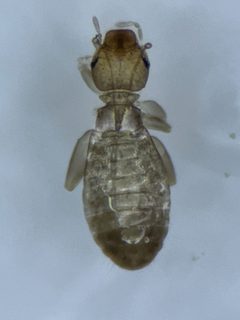
Minute, soft-bodied insect approximately 1 mm in length. Body coloration brown. Morphologically typical of booklice: small, flattened, with relatively long . Sex determination system is XO (males possess single ).
Habitat
Libraries, grain storages, and food-processing facilities. Frequently trapped in corners of storage facilities. Also recorded from nests of birds and mammals. Laboratory colonies maintained on artificial diet at 25°C and 75% relative humidity.
Distribution
Global distribution. Documented from North America (USA, Canada, Mexico), Europe (Great Britain, Austria, Belgium, Cyprus, Czech Republic, Finland, France, Germany, Greece, Italy, Luxembourg, Morocco, Norway, Poland, Portugal, Spain, Switzerland, Serbia, Yugoslavia), Asia (China), Africa (South Africa), and Australia. Specific specimens for sequencing collected from Oklahoma State, United States.
Diet
In laboratory conditions: wheat flour, yeast, and whole milk powder in 10:1:1 ratio. As a stored-product pest: seeds, raw agricultural materials, food, and feed.
Host Associations
- birds - found in nests
- mammals - found in nests
Life Cycle
Maintained for more than 100 breeding in laboratory conditions. stage exhibits particularly high resistance to phosphine . Developmental stages include egg, nymph, and .
Behavior
Typically aggregates in corners of grain storage facilities. Demonstrates remarkable survival capacity under heat treatment at 44°C. Exhibits high resistance to common including phosphine, deltamethrin, carbaryl, methoprene, spinosad, imidacloprid, and .
Ecological Role
Important storage pest causing 5–10% weight loss in agricultural commodities. Negatively influences commodity quality through associated with elevated moisture. Production of allergens affects human health. Potential involvement in transmission of to humans or animals.
Human Relevance
Major economic pest in stored-product protection. Inflicts substantial losses on agricultural commodities and food supplies. Health concerns include allergen production and possible transmission. Subject of intensive research due to exceptional resistance, informing pest management strategies and protocols.
Similar Taxa
- Liposcelis bostrychophilaAnother common stored-product booklouse; distinguished by specific and potentially different resistance profiles
- parasitic lice (Phthiraptera)Phylogenetically sister group; distinguished by Liposcelis brunnea being free-living rather than obligate ectoparasitic, and by expanded chemosensory gene in the
More Details
Genomic characteristics
First -level assembly for : 174.1 Mb, 9 linkage groups, 15,543 predicted genes. BUSCO completeness 98.9%, N50 19.7 Mb. Significant expansion of odorant binding proteins (OBP), olfactory receptors (OR), and detoxification gene (ABC transporters, esterases, glutathione S-transferases, UDP-glucuronosyltransferases, P450s) compared to parasitic lice.
Stress response mechanisms
CYP4 P450 genes function during phosphine . HSP70 genes upregulated under high temperature (44°C). These transcriptomic responses validated with 4 replicates per treatment.
Laboratory strain limitations
assembled from females of a laboratory strain maintained for over 100 ; this may not fully represent genetic diversity of wild .
Sources and further reading
- BugGuide
- GBIF taxonomy match
- iNaturalist taxon
- NCBI Taxonomy
- Catalogue of Life
- Ever Seen a Mantidfly? | Bug Squad
- Take a Bug Break--and Bring Along This Book | Bug Squad
- Bug Eric: Wasp Mantisfly
- When is a stag beetle not a stag beetle? | Beetles In The Bush
- A chromosome-level genome of the booklouse, Liposcelis brunnea, provides insight into louse evolution and environmental stress adaptation.