
Metylophorus novaescotiae
(Walker, 1853)
Speckled Barklouse
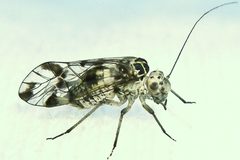
Metylophorus novaescotiae is a of barklouse in the Psocidae, commonly known as the Speckled Barklouse. It is one of the most frequently observed barklice in North America, with substantial iNaturalist documentation. The species was originally described by Francis Walker in 1853 under the basionym Psocus novaescotiae. It inhabits wooded environments where it feeds on lichens, , and organic debris on tree bark.
Pronunciation
How to pronounce Metylophorus novaescotiae: //mɛˌtaɪloʊˈfɔːrəs noʊˌveɪskɒti.aɪ//
These audio files are automatically generated. While they are not always 100% accurate, they are a good starting point.
Identification
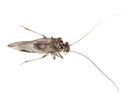
Metylophorus novaescotiae is recognized by its speckled or mottled wing patterning, which provides camouflage against bark surfaces. As a member of the Metylophorus, it possesses the characteristic broad, rounded wings held roof-like over the body when at rest. The can be distinguished from other barklice by its relatively large size within the Psocidae and its distinctively patterned forewings with dark markings on a pale background.
Images
Habitat
Found in forested and wooded areas, primarily on tree trunks and branches where it occupies the microhabitat of bark surfaces. Also occurs on wooden structures and fence posts in rural and suburban settings. Requires humid conditions and is typically found in shaded environments with abundant lichen growth.
Distribution
Native to North America, with records from Canada (including Nova Scotia, the type locality), the United States (including Vermont and widespread eastern and central regions), and Mexico. Extends into Central America. Present throughout the eastern deciduous forest biome and adjacent regions.
Seasonality
Active during warmer months; have been observed from spring through fall in temperate regions. Year-round activity is likely in subtropical and tropical portions of its range. Peak observation records occur during summer.
Diet
Feeds on lichens, , fungal , and organic detritus found on bark surfaces. Does not consume living plant tissue.
Life Cycle
Development progresses through , nymph, and stages. Nymphs resemble smaller, wingless versions of adults and occupy the same microhabitat. Multiple per year are likely in temperate regions, with continuous breeding possible in warmer climates. Specific details of egg-laying and nymphal instars are not well documented.
Behavior
Gregarious; often found in small on bark surfaces. Exhibits cryptic , remaining motionless when disturbed to rely on camouflage. Capable of short, fluttering when alarmed. or activity patterns suspected but not confirmed.
Ecological Role
Serves as a decomposer in forest , processing lichens, , and organic matter on bark surfaces. Provides a food source for small including spiders, predatory insects, and birds. Contributes to nutrient cycling in the and trunk microhabitats of trees.
Human Relevance
Generally harmless to human interests; does not damage structures, stored products, or living plants. Occasionally noticed on outdoor wooden furniture or fences but causes no damage. Presence indicates healthy, lichen-rich environments. Sometimes mistaken for that infest stored products, but this is exclusively outdoor-dwelling.
Similar Taxa
- Metylophorus purusSimilar size and wing shape, but lacks the distinct speckled pattern; wings are more uniformly colored or clear.
- Blaste spp.Overlaps in and general appearance, but Blaste typically have more elongate wings and different wing venation patterns.
- Loensia spp.Another found on bark, but Loensia are generally smaller with reduced wing pigmentation and different antennal proportions.
Misconceptions
Sometimes incorrectly associated with household booklice (Liposcelididae) that infest stored products; Metylophorus novaescotiae is exclusively an outdoor that does not invade homes or damage materials.
More Details
Taxonomic History
Originally described as Psocus novaescotiae by Francis Walker in 1853, later transferred to the Metylophorus. The specific epithet refers to Nova Scotia, Canada, the type locality.
Observation Frequency
With over 1,900 iNaturalist observations, this is among the most frequently documented barklice in North America, reflecting both its abundance and its relatively conspicuous size and patterning.