
Elipsocus pumilis
(Hagen, 1861)
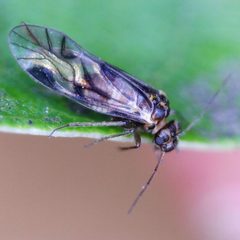
Elipsocus pumilis is a small psocopteran in the Elipsocidae, first described by Hagen in 1861. The species is characterized by its black coloration. It has been recorded across much of Europe, including Great Britain and Ireland, as well as parts of North America.

Pronunciation
How to pronounce Elipsocus pumilis: /ɛˈlɪpsəkəs ˈpjuːmɪlɪs/
These audio files are automatically generated. While they are not always 100% accurate, they are a good starting point.
Identification
The black coloration distinguishes it from many other psocopterans, which are often brown, gray, or mottled. Specific diagnostic features for distinguishing E. pumilis from are not documented in available sources.
Images
Appearance
Body is black in color. As a member of Psocodea, it is a small, soft-bodied insect with long .
Habitat
Associated with woody vegetation. Has been recorded on a broad range of trees and shrubs including alder, ash, beech, birch, bird cherry, blackthorn, broom, Chinese juniper, elder, fir, hawthorn, hazel, honeysuckle, juniper, larch, pine, sycamore, sea buckthorn, spruce, willow, and yew. Also found on fruits of horse chestnut, lime, and rowan.
Distribution
Native to Europe, with records from Great Britain, Ireland, Austria, Belgium, Luxembourg, Netherlands, Bulgaria, France, Germany, Greece, Hungary, Italy, Latvia, Poland, Romania, Spain, Switzerland, Scandinavia (Denmark, Finland, Norway, Sweden), and former Czechoslovakia, Yugoslavia, and USSR territories. Introduced or native also present in North America (Canada, USA, Mexico).
Diet
Feeds on fruits including horse chestnut, lime, and rowan. Also feeds on foliage or bark surfaces of numerous tree and shrub .