
Valenzuela burmeisteri
(Brauer, 1876)
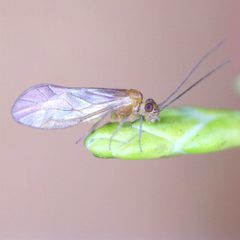
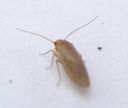
Valenzuela burmeisteri is a of barklouse in the Caeciliusidae. It is a small, winged insect with yellowish-black coloration. The species has a broad distribution across Europe, including the British Isles, and extends into the Near East. It has been recorded from numerous European countries and island groups including the Azores, Madeira, and Canary Islands.
Pronunciation
How to pronounce Valenzuela burmeisteri: /væləntˈsuːlɑ ˌbʊrmaɪˈstɛri/
These audio files are automatically generated. While they are not always 100% accurate, they are a good starting point.
Identification
Distinguishable by its yellowish-black color pattern among European Caeciliusidae. Positive identification requires examination of wing venation and genitalic structures typical of the Valenzuela.
Images
Habitat
Associated with various coniferous and broadleaf trees. Has been recorded in environments where beech, cedar, Chinese juniper, fir, hawthorn, hemlock, juniper, larch, oak, pine, Sequoia, spruce, and yew occur.
Distribution
Widespread across Europe including United Kingdom, Ireland, Austria, Belgium, Bulgaria, Croatia, Denmark, Finland, France, Germany, Greece, Hungary, Italy, Latvia, Luxembourg, Norway, Poland, Portugal, Romania, Spain, Sweden, Switzerland, and the Netherlands. Also present on Atlantic islands including Azores (Faial, Flores, Graciosa, Pico, São Jorge), Madeira, and Canary Islands. Range extends into the Near East.
Diet
Feeds on epiphytic material on trees including beech, cedar, Chinese juniper, fir, hawthorn, hemlock, juniper, larch, oak, pine, Sequoia, spruce, and yew.
Ecological Role
Decomposer; feeds on organic material on tree surfaces including , lichens, and detritus.