
Pteronarcys dorsata
(Say, 1823)
American salmonfly
Pteronarcys dorsata, the American salmonfly, is the largest in North America. This has a with occurring in spring. are primarily and do not feed. The species has been documented as a for phoretic Chironomidae larvae.
Pronunciation
How to pronounce Pteronarcys dorsata: /tɛroʊˈnɑrksɪs dɔrˈsɑtə/
These audio files are automatically generated. While they are not always 100% accurate, they are a good starting point.
Identification
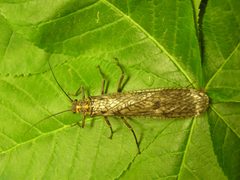
Distinguished from other stoneflies by its exceptional size—larger than any other North American plecopteran. timing in mid-March to early April in southwestern Virginia . lack functional mouthparts and do not feed, unlike many related . Nymphs can be recognized by their large size and association with river weed mats or leaf packs.
Images
Appearance
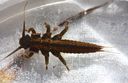
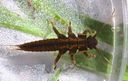
Large-bodied ; possess two pairs of membranous wings held flat over the body. As the largest stonefly in North America, individuals reach substantial size relative to other plecopterans. Nymphs are aquatic and robust, adapted for life in flowing water.
Habitat
Rivers and flowing water systems. Nymphs occupy mats of Podostemum ceratophyllum (river weed) during warm months, and shelter under large unembedded rocks or in leaf packs through winter months. Documented in warm water fourth-order rivers.
Distribution
North America. Specific records include: Alberta, Alabama, Alaska, British Columbia, and Florida. Documented in rivers of central and northern Saskatchewan, and in southwestern Virginia.
Seasonality
active in spring and summer. occurs mid-March to first week of April in southwestern Virginia . Adults may live up to 42 days.
Diet
Larvae feed on diatoms and detritus. do not feed.
Life Cycle
(one year ) in warm water rivers; previously reported as 2-4 years in cooler conditions. hatch in 23-38 days. Early nymphal instars appear by mid-June. Nymphs reach maximum size by late November or December. Mean is 242 eggs, with up to four separate egg batches produced per female.
Behavior
Primarily . When threatened, release a noxious fluid from leg joints or feign death (). Phoretic Chironomidae larvae attach to nymphs, most frequently on the .
Ecological Role
as nymph, processing organic material in aquatic systems. Serves as for phoretic larvae; eight Chironomidae have been documented in phoretic association with nymphs.
Human Relevance
Indicator of river health and water quality. Presence used in biomonitoring of aquatic .
Similar Taxa
- Other Pteronarcys speciesSmaller body size; P. dorsata is distinguished as the largest North American
- Other Plecoptera familiesSmaller size and different timing; Pteronarcyidae are notably larger than most
More Details
Phoretic associations
Eight Chironomidae documented as phoretic ectosymbionts on nymphs: Cricotopus sp. nr. tremulus, Tvetenia vitracies, Nanocladius (s.s.) cf. rectinervis, Nanocladius branchicolus, Nanocladius (s.s.) cf. spiniplenus, Paratanytarsus confusus, Polypedilum (s.s.) convictum, and Rheotanytarsus sp. Rheotanytarsus sp. and P. convictum were most common.
Temperature effects on life cycle
Higher water temperatures of longer duration enable completion of in one year rather than the 2-4 years reported from cooler environments.
Sources and further reading
- BugGuide
- Wikipedia
- GBIF taxonomy match
- iNaturalist taxon
- NCBI Taxonomy
- Catalogue of Life
- Where Giant Honey Bees Rest Their Wings During Annual Migration
- Walking Among Giants in Northwest Thailand
- Lab Test Rapidly IDs Potential Mite Pest of Honey Bees
- Scorching plains, screaming cactus | Beetles In The Bush
- New Research Links Honey Bee Swarms to the Spread of an Invasive Mite
- Hitching a Ride: Why a New Mite Might Vex U.S. Beekeepers
- The life history of Pteronarcys dorsata (Say) (Plecoptera: Pteronarcyidae) in southwestern Virginia
- FIRST RECORDS OF PHORETIC CHIRONOMIDAE (DIPTERA) ASSOCIATED WITH NYMPHS OFPTERONARCYS DORSATA(SAY) (PLECOPTERA: PTERONARCYIDAE)