
Pteronarcys californica
Newport, 1848
giant salmonfly, salmonfly, California giant stonefly
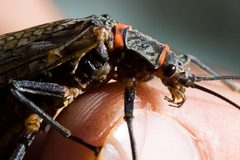
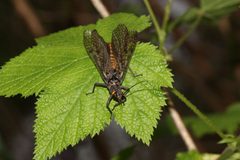
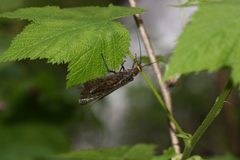
Pteronarcys californica, commonly called the giant salmonfly, is among the largest stoneflies in North America. The nymphal stage lasts 3–4 years in cold, well-oxygenated rivers, after which emerge in synchronized mass events during late spring to early summer. Adults are strikingly colored with bright orange , leg joints, and segments, and carry masses resembling clusters of salmon roe. The serves as a critical food source for salmonid fishes and is highly valued by fly anglers, making it both ecologically and culturally significant across western North American river systems.
Pronunciation
How to pronounce Pteronarcys californica: /ˌtɛroʊˈnɑrsɪs ˌkælɪˈfɔrnɪkə/
These audio files are automatically generated. While they are not always 100% accurate, they are a good starting point.
Identification
Distinguished from other stoneflies by its exceptional size—nymphs exceed 5 cm and are among the largest Plecoptera in North America. The bright orange coloration of the , leg joints, and in adults is diagnostic. The orange mass carried by females at the abdomen tip is unique among regional stoneflies. Nymphs are recognized by their large size, dark surface with lighter venter, and presence in high-velocity, cold-water with coarse substrates.
Images
Habitat
Cold, well-oxygenated streams and rivers with moderate to high water velocity. Nymphs require coarse, unconsolidated substrates (cobbles, boulders) with low fine sediment (<2 mm) and low cobble embeddedness. Optimal conditions include riffle with heterogeneous flow velocities. Currently rare or extirpated where maximum weekly August temperatures exceed 18.6°C.
Distribution
Western North America from British Columbia and Alaska south to California, and eastward through the Rocky Mountains to Alberta and Montana. Found in rivers draining the Coast, Cascade, Sierra Nevada, and Rocky mountain ranges. Historical range in some river systems (e.g., Madison River, Montana) has contracted due to thermal degradation below dams.
Seasonality
Nymphs present year-round in aquatic for 3–4 years. emerge in synchronized mass events during late spring to early summer (May–June in most regions). timing is highly synchronous among individuals within .
Diet
Nymphs are and "," consuming allochthonous detritus (68% of gut contents by volume), amorphous detritus, diatoms, and filamentous . Minor -related variation occurs: nymphs from rocky substrates consume more diatoms than those from woody debris. profiles indicate significant contribution from diatoms and green algae as nutritional sources.
Life Cycle
Embryonic development with early lasts approximately 1 year. Nymphal stage extends 3–4 years (up to 5 years in some ) with multiple and extended recruitment leading to cohort splitting. instar undergoes final molt the following spring. emerge synchronously, reproduce immediately, and die shortly after. Total time approximately 4–5 years.
Behavior
Nymphs exhibit behavioral and oxygen-seeking: when exposed to warm or hypoxic conditions, they actively relocate to microhabitats with higher flow velocities to increase oxygen delivery. This exploitation of microspatial flow heterogeneity is the primary behavioral mechanism for mitigating physiological stress. show highly synchronized mass , likely mediated by a summer in antepenultimate-instar larvae. Prior to emergence, nymphs migrate from river centers to shoreline shallows and congregate on partially exposed rocks.
Ecological Role
Critical macroinvertebrate prey for cold-water salmonid fishes. Serves as important nutrient input to aquatic and terrestrial during mass events. Controls organic matter processing as a , converting coarse detritus into fine particulate organic matter. Acts as a bioindicator : presence indicates high-quality coldwater , while decline signals thermal degradation or sedimentation. Synchronized emergences represent immense nutrient pulses linking aquatic and riparian .
Human Relevance
Highly significant to recreational fly fishing; and nymph patterns are extensively tied to imitate this . The spring period is considered a highlight of the fishing season in western rivers. Serves as a flagship species for river conservation and restoration efforts. declines have prompted improvement projects and direct reintroduction attempts in some river systems.
Similar Taxa
- Pteronarcella badiaOverlapping distribution and use; distinguished by smaller size and different timing.
- Other Pteronarcys speciesShare characteristics but differ in distribution, size, and coloration; P. californica is the largest and most widely distributed in western North America.
- Acroneuria spp.Large predatory stoneflies in same order but different ; distinguished by predatory habit, different mouthpart , and lack of bright orange coloration.
Sources and further reading
- BugGuide
- Wikipedia
- GBIF taxonomy match
- iNaturalist taxon
- NCBI Taxonomy
- Catalogue of Life
- The Big 43: The California Native Plants, Plus One, Studied in UC Davis Research | Bug Squad
- Bohart Museum: Learn about California's State Insect on UC Davis Picnic Day | Bug Squad
- A Mural Like No Other | Bug Squad
- A Flash of Orange: Welcome, California Tortoiseshell! | Bug Squad
- California Dogface Butterfly: What the Fire Did | Bug Squad
- Bembicid Holdings | Entomology Research Museum
- Quantifying the habitat preferences of the stoneflyPteronarcys californicain Colorado
- Thermal tolerance of giant salmonfly nymphs (Pteronarcys californica) varies across populations in a regulated river
- Plasticity of salmonfly (Pteronarcys californica) respiratory phenotypes in response to changes in temperature and oxygen
- Sexual differences in the growth of Pteronarcys californica Newport and Pteronarcella badia (Hagen) (Plecoptera)
- Going with the flow – how a stream insect, Pteronarcys californica, exploits local flows to increase oxygen availability
- Going with the flow – how a stream insect, Pteronarcys californica , exploits local flows to increase oxygen availability
- A Comparison of Methods for Analysis of a Long Aquatic Insect Life History: Pteronarcys Californica (Plecoptera) in the Crowsnest River, Alberta
- Larval growth and development of the stonefly Pteronarcys californica (Insecta: Plecoptera) in the Crowsnest River, Alberta
- Dietary composition and fatty acid content of giant salmonflies (Pteronarcys californica) in two Rocky Mountain rivers
- An unusually large genome from an unusually large stonefly: A chromosome-length genome assembly for the giant salmonfly, Pteronarcys californica (Plecoptera: Pteronarcyidae).