
Taenionema
Banks, 1905
winter stoneflies
Species Guides
4- Taenionema atlanticum(Atlantic willowfly)
- Taenionema californicum(California willowfly)
- Taenionema kincaidi(Pale Willowfly)
- Taenionema oregonense(Oregon Willowfly)
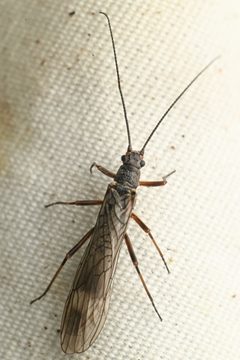
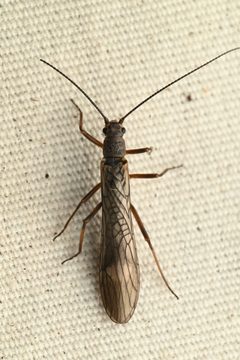
Taenionema is a of winter stoneflies (Plecoptera: Taeniopterygidae) comprising approximately 14 described . The genus was established by Banks in 1905 with Taenionema analis as the type species. Species are distributed across the Nearctic and eastern Palearctic regions, with 13 species native to North America and one species (T. japonicum) ranging across Japan, Korea, Mongolia, Russia and northeastern China. A second Eastern Hemisphere species, T. sinensis, was described in 2023 from southeastern China.
Pronunciation
How to pronounce Taenionema: /tiːniːoʊˈniːmə/
These audio files are automatically generated. While they are not always 100% accurate, they are a good starting point.
Identification
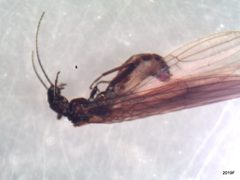
Distinguished from other Taeniopterygidae by the combination of forked RP and CuA in forewings, the distinctive hind margin of male sternum 9 (medially depressed, laterally elevated), and the presence of distinct lobes on male 10. Larvae lack the silky fringe hairs on characteristic of some related . T. sinensis can be identified by larval characters including the subgenital plate and hook-shaped paraprocts in males.
Images
Habitat
Moderately-sized creeks up to 10 m wide with fast-flowing, clear water and boulder-cobble substrates. Most occupy higher elevation creeks and small rivers; T. sinensis occurs in low-elevation coastal areas. Streams typically support diverse .
Distribution
Nearctic Region: 13 in North America. Eastern Palearctic Region: T. japonicum in Japan, Korea, Mongolia, Russia and northeastern China; T. sinensis in Zhejiang and Fujian Provinces, southeastern China.
Seasonality
occurs in early March for T. sinensis; specific timing for other not documented in available sources.
Life Cycle
Larval development occurs in aquatic environments. documented in early March for T. sinensis. Larval described for T. sinensis including subgenital plate and hook-shaped paraprocts in males.
Behavior
primarily encountered on stream-side vegetation. One male adult of T. sinensis captured in light trap, suggesting possible positive . occur at low in surveyed locations.
Ecological Role
Member of diverse co-occurring with Leuctridae, Nemouridae, Peltoperlidae, Perlidae, Perlodidae and in shared streams. Functional role as aquatic / inferred from -level characteristics but not directly documented.
Similar Taxa
- Other Taeniopterygidae generaTaenionema distinguished by unique combination of wing venation (forked RP and CuA), male sternum 9 , and male 10 lobes; related lack this specific character suite
More Details
Taxonomic history
established by Banks in 1905 with Taenionema analis as type . T. sinensis represents first Chinese species and second Eastern Hemisphere species described, expanding known biogeographic range.
Population status
T. sinensis documented at low densities in both Zhejiang and Fujian Provinces; general abundance patterns for other not reported.