
Odontoxiphidium apterum
Morse, 1901
Wingless Meadow Katydid
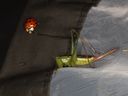
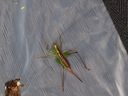
Odontoxiphidium apterum, commonly known as the Wingless Meadow Katydid, is a flightless of bush in the Tettigoniidae. It is characterized by the complete absence of wings in both sexes, a rare trait among katydids. The species is restricted to the southeastern United States, where it inhabits grassland and meadow . Its wingless condition distinguishes it from nearly all other North American katydids.
Pronunciation
How to pronounce Odontoxiphidium apterum: /oʊˌdɒntoʊˈzɪfɪdiəm ˈæptərəm/
These audio files are automatically generated. While they are not always 100% accurate, they are a good starting point.
Identification
The complete absence of wings in is diagnostic and immediately separates this from all other North American katydids except its Odontoxiphidium dorsale. O. apterum can be distinguished from O. dorsale by geographic range (O. dorsale occurs west of the Mississippi River) and subtle differences in pronotal shape. The combination of small size, wingless condition, and southeastern U.S. distribution confirms identification.
Images
Appearance
A small to medium-sized with a compact, robust body. Both sexes are completely wingless, lacking both forewings and hindwings. The pronotum is extended posteriorly, covering much of the . Coloration is typically green or brown, providing camouflage in grassy vegetation. are long and thread-like, extending well beyond the body length. Females possess a prominent, sword-like ovipositor.
Habitat
Grassy meadows, prairies, and open grasslands. Associated with herbaceous vegetation in sunny, open . Often found in moist to mesic meadows with dense ground cover.
Distribution
Southeastern United States: Alabama, Florida, Georgia, Mississippi, and North Carolina. Range restricted to the Atlantic and Gulf coastal plains.
Seasonality
active from summer through early autumn, with peak activity in July through September. Nymphs present in spring and early summer.
Behavior
Ground-dwelling or low in vegetation due to flightless condition. Males produce calling songs to attract females. Movement is primarily by or jumping; cannot fly.
Ecological Role
Herbivore in grassland . Serves as prey for birds, spiders, and other . Contributes to nutrient cycling through herbivory.
Human Relevance
No significant economic or cultural importance. Occasionally encountered by naturalists and entomologists due to its unusual wingless . Not considered a pest .
Similar Taxa
- Odontoxiphidium dorsaleOnly other North American wingless ; distinguished by western distribution (west of Mississippi River) and subtle pronotal differences
- Conocephalus spp.Similar meadow katydid and appearance, but all Conocephalus possess fully developed wings
- Orchelimum spp.Similar size and meadow , but possess wings and have different song characteristics
More Details
Winglessness
The specific epithet 'apterum' (meaning 'wingless') refers to the complete absence of wings. This condition is extremely rare in Tettigoniidae and represents an evolutionary to stable, open grassland where offers limited advantage.
Conservation status
Not formally assessed by IUCN, but loss of native grasslands and meadows in the southeastern U.S. may pose localized threats.