
Gryllotalpa
Latreille, 1802
mole crickets
Species Guides
2- Gryllotalpa gryllotalpa(European mole cricket)
- Gryllotalpa major(prairie mole cricket)
Gryllotalpa is a of mole crickets in the Gryllotalpidae, characterized by highly modified front legs adapted for digging. The genus contains numerous distributed across Africa, Europe, Asia, Australia, and the Americas, with several cryptic distinguished primarily by song patterns. Species within this genus are found in diverse ranging from steppe zones and wet grasslands to gardens and agricultural fields. Some species, particularly Gryllotalpa gryllotalpa, are of conservation concern in parts of Europe while also being agricultural pests in other regions.
Pronunciation
How to pronounce Gryllotalpa: //ɡrɪlˈlɒtəlpə//
These audio files are automatically generated. While they are not always 100% accurate, they are a good starting point.
Identification
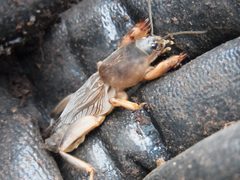
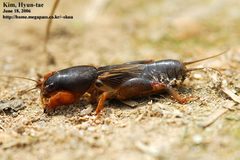
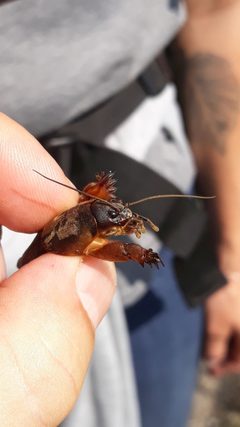
Mole crickets are immediately recognizable by their mole-like, front legs—broad, flattened, and bearing teeth or dactyls for digging. This distinguishes them from all other Orthoptera. Within the , identification requires examination of: (1) the arrangement of tibial dactyls on the front legs (widely separated vs. close together), (2) the structure of the epiphallus in males, (3) male tegminae venation patterns, and (4) the inner part of the hind tibia. Several species form cryptic complexes distinguishable primarily by song patterns. Gryllotalpa gryllotalpa can be distinguished from the similar G. stepposa and G. unispina by specific morphological characters of the male genitalia and wing venation.
Images
Habitat
Diverse soil-based including steppe zones, wet grasslands, marshes, meadows, gardens, agricultural fields, and forest nurseries. In Slovakia, 72% of records were below 350 m elevation, with wet grasslands and marshes being primary habitats in natural settings, while gardens dominated secondary habitat records. show preference for warm, relatively dry conditions with workable soil for burrowing.
Distribution
Widespread across multiple continents. In Europe: from the British Isles (rare, protected) through central and eastern Europe including Slovakia, Hungary, Romania, Serbia, Bulgaria, Greece, and eastward through the Caucasus and central Asia. In Africa: multiple across the continent. In Asia: from the Middle East through India to China, Japan, and Southeast Asia. In Australia: several species. In the Americas: G. cultriger in Mexico and G. major in the USA, plus introduced of other species. Some species have been introduced outside native ranges.
Seasonality
Activity patterns vary by and climate. are typically active during warmer months. In temperate regions, activity extends from spring through autumn, with mating and -laying occurring in spring and summer. Warmth-loving species require warm, relatively dry springs to reach adulthood and mate before summer's end.
Diet
, feeding on plant roots, tubers, and other underground plant material, as well as soil . Some are significant agricultural pests of vegetable crops and turf. The gut contains , amylase, , trypsin, and chymotrypsin , indicating capacity for both protein and digestion.
Life Cycle
Hemimetabolous development with , nymph, and stages. Eggs are laid in chambers constructed in soil. Nymphs resemble small adults without fully developed wings. Development includes multiple nymphal instars. Some exhibit parental care of eggs and young nymphs. Wing occurs in some species, with short-winged flightless forms and long-winged dispersing forms.
Behavior
Primarily , spending most of their life in underground burrows. Capable of rapid running on the surface but do not jump like true crickets. When disturbed, individuals may exhibit (playing dead) briefly before bolting to safety. Males produce -specific calling songs using stridulatory structures on the forewings; songs are important for species identification in cryptic complexes. Some ability to survive accidental submersion due to water-repellent body hairs providing buoyancy. Mating involves the female mounting the male, with sperm transferred in an external .
Ecological Role
Soil engineers through burrowing activities that aerate soil. Serve as prey for various vertebrate and . Some are for parasitic such as Oscheius myriophila. and distribution serve as indicators of climate change, with range expansions documented in response to warming temperatures.
Human Relevance
Agricultural pests in many regions, damaging vegetable crops, turf, and pastures by feeding on roots and underground plant parts. Subject to control efforts including chemical and mechanical methods. In Europe, Gryllotalpa gryllotalpa is legally protected in the UK due to rarity and loss, representing a conservation priority. Used as research organisms for studies on neuroendocrine control of digestion, systems, and habitat modeling. Difficult to distinguish from introduced pest such as in some regions, complicating management decisions.
Similar Taxa
- ScapteriscusIntroduced in the Americas; distinguished by tibial dactyl arrangement and other morphological features. borellii has widely separated tibial dactyls and is an pest in the southeastern USA, whereas native Gryllotalpa in the region have different dactyl arrangements.
- GryllusTrue crickets in Gryllidae; lack front legs and instead have enlarged hind legs for jumping. Have longer and different sound production mechanism (forewing against forewing rather than leg against wing as in some grasshoppers).
- Gryllotalpa stepposaClosely related within the same , morphologically similar to G. gryllotalpa but distinguishable by epiphallus structure, male tegminae venation, and hind tibia characters. Found in steppe zones and expanding westward in southeastern Europe.
More Details
Cryptic species diversity
The Orthoptera File indicates numerous cryptic species within Gryllotalpa, often distinguished only by song patterns. This includes species groups around G. africana, G. australis, G. gryllotalpa, G. monanka, G. oya, G. parva, G. pilosipes, and G. pluvialis, indicating substantial unrecognized or recently described diversity.
Chromosome variation
Gryllotalpa gryllotalpa exhibits complex systems with multiple chromosome races, including G. septemdecimchromosomica with 17 chromosomes, suggesting ongoing speciation processes.
Conservation status variation
within this show markedly different conservation statuses across their ranges. Gryllotalpa gryllotalpa is rare and legally protected in the UK but common in eastern Europe; this variation reflects specialization and poor ability in some versus adaptability to anthropogenic habitats in others.
Sources and further reading
- BugGuide
- Wikipedia
- GBIF taxonomy match
- iNaturalist taxon
- NCBI Taxonomy
- Catalogue of Life
- The Changing Distributions of our Grasshoppers, Crickets and Relatives - Buglife Blog - Buglife
- What’s the difference between a cricket and a grasshopper? - Buglife Blog - Buglife
- Who likes mole crickets? | Beetles In The Bush
- Figure 1 from: Iorgu IS, Iorgu EI, Puskás G, Ivković S, Borisov S, Gavril VD, Chobanov DP (2016) Geographic distribution of Gryllotalpa stepposa in south-eastern Europe, with first records for Romania, Hungary and Serbia (Insecta, Orthoptera, Gryllotalpidae). ZooKeys 605: 73-82. https://doi.org/10.3897/zookeys.605.8804
- Figure 1 from: Iorgu IȘ, Iorgu EI, Puskás G, Ivković S, Borisov S, Gavril VD, Chobanov DP (2017) Corrigenda: Iorgu IȘ, Iorgu EI, Puskás G, Ivković S, Borisov S, Gavril VD, Chobanov DP (2016) Geographic distribution of Gryllotalpa stepposa (Insecta, Orthoptera, Gryllotalpidae) in South-eastern Europe, with first records for Romania, Hungary and Serbia. ZooKeys 605: 73-82, doi: 10.3897/zookeys.605.8804. ZooKeys 671: 155-156. https://doi.org/10.3897/zookeys.671.13116
- Figure 2 from: Iorgu IS, Iorgu EI, Puskás G, Ivković S, Borisov S, Gavril VD, Chobanov DP (2016) Geographic distribution of Gryllotalpa stepposa in south-eastern Europe, with first records for Romania, Hungary and Serbia (Insecta, Orthoptera, Gryllotalpidae). ZooKeys 605: 73-82. https://doi.org/10.3897/zookeys.605.8804
- Using Habitat-Suitability Models to Improve Management of the Mole Cricket (Gryllotalpa Gryllotalpa) in Gardens and Forest Nurseries
- Distribution of the European mole cricket Gryllotalpa gryllotalpa (Orthoptera) in Slovakia
- The Chromosome Sets ofGryllotalpa GryllotalpaL. and their Geographical Distribution
- Activity and Distribution of Five Digestive Enzymes in the Gut of Gryllotalpa Gryllotalpa Curtis (Gryllotalpidae: Orthoptera) After Allatectomy, Brain Cauterization and Juvenoid Treatment.
- THE KNOWLEDGE NEEDS OF VEGETABLE FARMERS IN HAMAM AL-ALIL DISTRICT / NINEVEH GOVERNORATE IN THE FIELD OF GRYLLOTALPA GRYLLOTALPA CONTROLLING
- Supplementary material 1 from: Iorgu IS, Iorgu EI, Puskás G, Ivković S, Borisov S, Gavril VD, Chobanov DP (2016) Geographic distribution of Gryllotalpa stepposa in south-eastern Europe, with first records for Romania, Hungary and Serbia (Insecta, Orthoptera, Gryllotalpidae). ZooKeys 605: 73-82. https://doi.org/10.3897/zookeys.605.8804
- Isolation and Characterization of a Parasitic Nematode, Oscheius myriophila (Nematoda: Rhabditida), Associated with European Mole Cricket, Gryllotalpa gryllotalpa (Orthoptera: Gryllotalpidae)
- The habitat-suitability models of the European mole cricket (Gryllotalpa gryllotalpa) as information tool for conservation and pest management