
Velarifictorus micado
(Saussure, 1877)
Japanese Burrowing Cricket
Velarifictorus micado, the Japanese burrowing , is a true cricket native to East Asia that was introduced to the eastern United States in 1959. The exhibits two distinct modes: and nymphal diapause, which vary geographically across its native range. In North America, it has expanded from the eastern seaboard to the eastern Great Plains and northern United States, with recent observations suggesting it is more mobile and potentially more ecologically impactful than previously assumed.
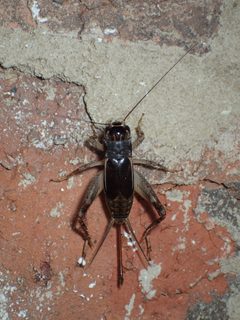
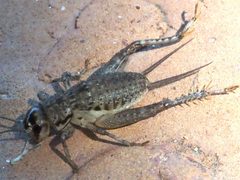
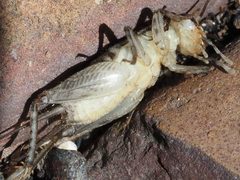
Pronunciation
How to pronounce Velarifictorus micado: /vɛ.la.rɪˈfɪk.tər.əs mɪˈkɑː.dɔ/
These audio files are automatically generated. While they are not always 100% accurate, they are a good starting point.
Identification
The can be distinguished from native North American field crickets by its association with human-modified and its documented ability to produce (long-winged) individuals capable of . Detection during acoustic surveys is maximized at sunset and declines through the night to near-zero by midday, which may aid in distinguishing it from sympatric species with different activity patterns.
Images
Habitat
Primarily associated with urban and human-modified environments, including residential areas and landscaped settings. Recent collections indicate expanding use of more remote and atypical beyond urban cores.
Distribution
Native to East Asia, with spanning from the Amur region and Manchuria through central and southeastern China. Introduced to the eastern United States in 1959; established populations now extend throughout the eastern half of the country, including the eastern Great Plains and northern United States. Continued range expansion has been documented through citizen science observations.
Seasonality
activity and detectability peak in September and decline linearly through November. Acoustic detection is highest at sunset and lowest near sunrise and midday.
Life Cycle
Two discrete modes occur in the native range: (slow-hatching) and nymphal diapause (fast-hatching). These modes are geographically structured, with egg diapause lineages predominant in northern and south-central regions and nymphal diapause lineages in deep southern regions of East Asia. Photoperiodic responses in nymphal development differ between the two forms, with each showing slower development under specific day-length conditions that synchronize stages.
Behavior
Considered relatively passive and non-destructive in early literature, though this characterization is being reassessed. Produces acoustic signals detectable during point count surveys. Some individuals develop long wings (macroptery) enabling , which has facilitated range expansion into non-urban .
Ecological Role
Potential ecological impacts in North America are under investigation following observations in atypical ; specific effects remain undocumented.
Human Relevance
Introduced of interest for monitoring and potential management. Citizen science platforms (BugGuide, iNaturalist) have proven effective for tracking its expanding range. Subject of acoustic monitoring protocol development for surveillance.
Similar Taxa
- Native Gryllus field cricketsOverlap in acoustic activity and general ; V. micado distinguished by association with human-modified environments and documented macroptery enabling
Misconceptions
Early literature characterized the as strictly urban and non-, but recent evidence demonstrates -capable , establishment in non-urban , and northward range expansion suggesting greater invasive potential than previously recognized.
More Details
Genetic Structure and Invasion History
Native East Asian comprise three mitochondrial lineages (NE, SE, SN) diverging during the Middle Pleistocene around 0.79 and 0.50 million years ago, associated with cooling climate events and glacial development on the Qinghai-Tibet Plateau. North American populations originated from at least two independent events from the NE and SE lineages.
Acoustic Survey Detection
Detection probability in point count surveys is strongly influenced by time of day and date, with optimal conditions in September during the hours immediately preceding sunset. Barometric pressure, temperature, and wind speed showed weaker effects in studied .
Sources and further reading
- BugGuide
- Wikipedia
- GBIF taxonomy match
- iNaturalist taxon
- NCBI Taxonomy
- Catalogue of Life
- Introduced Japanese burrowing cricket (Orthoptera: Gryllidae: Velarifictorus (Velarifictorus) micado) range continues to expand in North America
- Discrete Modes of Life Cycle in Velarifictorus micado Species Complex (Orthoptera: Gryllidae)
- Assessing Factors Associated With Detection Probability of the Japanese Burrowing Cricket ( Velarifictorus micado ) on Point Count Surveys
- The genetic differentiation of a cricket (Velarifictorus micado) with two modes of life cycle in East Asia after the middle Pleistocene
- The genetic differentiation of a cricket ( Velarifictorus micado ) with two modes of life cycle in East Asia after the middle Pleistocene and the invasion origin of the United States of America
- Jumping Kinematics and Performance in Fighting Crickets Velarifictorus micado.