
Gryllus personatus
Uhler, 1864
Badlands Cricket, Badlands Field Cricket
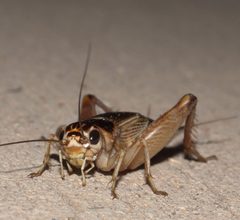
Gryllus personatus, commonly known as the badlands or badlands field cricket, is a of field cricket in the Gryllidae. It inhabits arid and semi-arid regions of southwestern North America, including desert and dry grassland environments. The species is named for its association with badlands terrain. Like other field crickets in the Gryllus, it produces characteristic chirping sounds through stridulation of specialized wing structures.
Pronunciation
How to pronounce Gryllus personatus: //ˈɡrɪl.əs pərˈsoʊ.neɪ.təs//
These audio files are automatically generated. While they are not always 100% accurate, they are a good starting point.
Images
Habitat
Desert and dry grassland, including badlands terrain. Typically found in arid and semi-arid environments with sparse vegetation and exposed soil surfaces.
Distribution
Northern Mexico and the United States, ranging north to South Dakota and west to southern California. Specific distribution records include Arizona, Kansas, and New Mexico.
More Details
Taxonomic Status
Gryllus personatus was described by Uhler in 1864. The Catalogue of Life lists this as a synonym, while GBIF and NCBI recognize it as an accepted species. Further taxonomic verification may be warranted.
Sources and further reading
- BugGuide
- Wikipedia
- GBIF taxonomy match
- iNaturalist taxon
- NCBI Taxonomy
- Catalogue of Life
- Host and a Parasite: Battle of Sand Field Crickets vs. Horsehair Worms | Bug Squad
- Home invaders III - Fall field cricket, Gryllus pennsylvanicus — Bug of the Week
- The troubadour downstairs – fall field cricket, Gryllus pennsylvanicus — Bug of the Week
- What’s all this chirping about? Ask the fall field cricket, Gryllus pennsylvanicus — Bug of the Week
- Field crickets invade a home with a wake-up call: Fall field cricket, Gryllus pennsylvanicus — Bug of the Week
- What do insects do in winter, Part 2? Tolerating the big chill: Banded woolly bears, Pyrrharctia isabella, field crickets, Gryllus spp., baldfaced hornets, Dolichovespula maculata, and others — Bug of the Week