
Anurogryllus arboreus
Walker, 1973
Common Short-tailed Cricket, Arboreal Short-tailed Cricket
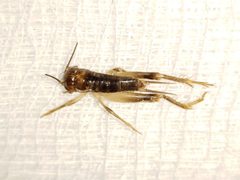
Anurogryllus arboreus is a burrowing native to the southern and southeastern United States. are pale brown with ovipositors and shed their wings shortly after maturation, becoming permanently flightless. Males call from elevated perches at night to attract females. The was separated from the widespread Anurogryllus muticus in 1973 based on male calling and morphological differences.
Pronunciation
How to pronounce Anurogryllus arboreus: //æn.jʊˌrɒ.ˈɡrɪl.ləs ɑːrˈbɔːr.i.əs//
These audio files are automatically generated. While they are not always 100% accurate, they are a good starting point.
Identification
Distinguished from Anurogryllus muticus by male calling and specific morphological traits; from A. celerinictus (Florida Keys only) by geographic range. The ovipositor and wing-shedding behavior are diagnostic for the ; identification requires examination of male calling behavior and subtle morphological differences.
Images
Habitat
Terrestrial; occupies self-constructed underground burrows in soil. Burrows typically 10–20 cm deep with side chambers for residence and feeding, plus a refuse chamber. Some lateral tunnels extend to plant roots for feeding without surfacing. Burrow entrance usually plugged with soil or vegetation when the is inside.
Distribution
Atlantic coastal plain from New Jersey south to Florida and westward to southeastern Texas. Records from Alabama, Arizona, Florida, Georgia, and Illinois.
Seasonality
Breeding occurs once annually between April and June. active year-round in suitable climates within range.
Diet
Feeds on plant roots accessed via lateral tunnels; also gathers vegetation for provisioning nymphs.
Life Cycle
breeding cycle. Female lays several dozen in a breeding chamber, tends them by palpation and turning, and deposits vegetation for newly-hatched nymphs. Female also lays trophic (unfertilized) eggs as food for nymphs. Nymphs remain in compact group, often on chamber roof, and follow female when nearby. Female typically dies when nymphs are part-grown; nymphs then disperse and construct individual burrows.
Behavior
Solitary and ; constructs and maintains elaborate burrow systems. Males dig temporary burrows; females may occupy one burrow for extended periods. Males emerge at nightfall and call from elevated perches (trees or other high structures) in early night hours. Female aggressively defends burrow against male intrusion. Burrow entrance kept plugged when is not foraging or seeking mates.
Ecological Role
Soil engineer through burrow construction; nutrient cycling via decomposition of plant material in refuse chambers; herbivore feeding on plant roots.
Similar Taxa
- Anurogryllus muticusFormerly considered ; distinguished by male calling and morphological differences per Walker 1973 revision
- Anurogryllus celerinictusOnly other U.S. ; restricted to Florida Keys, separated by geographic distribution
More Details
Taxonomic History
Split from Anurogryllus muticus by T.J. Walker in 1973 based on behavioral and morphological evidence; previously nearly all U.S. short-tailed crickets were assigned to A. muticus
Parental Care
Female exhibits extended parental care including tending, provisioning with vegetation, and production of for nymph nourishment—unusual among crickets