
Anurogryllus
Saussure, 1877
short-tailed crickets
Species Guides
2- Anurogryllus arboreus(Common Short-tailed Cricket)
- Anurogryllus celerinictus(Indies short-tailed cricket)
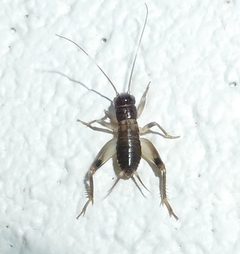
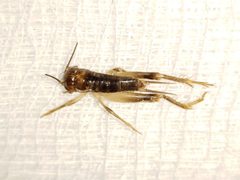
Anurogryllus is a of wingless, burrowing crickets known as short-tailed crickets, distributed throughout the Americas from the United States to Argentina. The genus is distinguished by females having , poorly developed ovipositors—hence the name "short-tailed." construct permanent underground burrows in firm soils and exhibit complex and territorial mating systems. The genus serves as for tachinid flies and includes species that can be agricultural pests.
Pronunciation
How to pronounce Anurogryllus: //æn.jʊə.roʊˈɡrɪl.ləs//
These audio files are automatically generated. While they are not always 100% accurate, they are a good starting point.
Identification
Females distinguished from other by , poorly developed ovipositor (the "short tail"). Both sexes wingless and flightless. Males possess stridulatory apparatus for sound production; females have reduced stridulatory structures. Burrow entrances marked by soil mounds in firm, sandy-clay loam soils.
Images
Habitat
Firm, sandy-clay loam soils with 1–3 inches of loose surface soil; open areas including pastures, lawns, roadsides, cultivated fields, and other disturbed . Requires soil suitable for constructing permanent burrows.
Distribution
Americas: United States (New Jersey to Florida, west to Texas, with records from Alabama and Arizona), Caribbean islands, Mexico, Central America, and South America (Argentina, Bolivia, Brazil).
Seasonality
with activity primarily June–October in temperate regions; through winter, hatching March–April; nymphal development 10–12 weeks.
Diet
: feeds on plant material including grasses, clover, weeds, and vegetable seedlings; consumes dead insects and probably small living insects.
Host Associations
- Euphasiopteryx depleta - Tachinid fly; Anurogryllus serve as alternate beyond primary hosts
Life Cycle
: laid June–October in sealed underground within or near burrows, averaging 174 eggs per female; eggs overwinter in ; hatch March–April; 8–10 nymphal instars over 10–12 weeks; present June–October; stage is egg.
Behavior
. Males construct and defend permanent burrows as mating territories; produce loud calling songs (92–95 dB SPL at 20 cm) from burrow entrances beginning at dusk, under circadian control. Females approach calling males and enter burrows for mating; plug burrow entrances with soil after entry. Males exhibit mate-guarding and produce courtship songs when females enter. Resource defense mating system with aggressive territorial defense. Multiple brief matings compensate for high energetic costs of calling.
Ecological Role
Soil aeration through extensive burrowing activity; prey for various ; alternate for tachinid flies. Some are minor agricultural pests of vegetable seedlings and young plants.
Human Relevance
Potential pest of vegetable seedlings and young plants in cultivated fields and gardens; otherwise generally harmless. Subject of ecological and behavioral research due to complex mating systems and .
Similar Taxa
- GryllusBoth are burrowing crickets in tribe Gryllini; Anurogryllus distinguished by ovipositor in females and wingless, flightless condition in both sexes
- TeleogryllusSimilar acoustic and mating systems; Anurogryllus differs in wingless condition, burrow-based territoriality, and female ovipositor structure
More Details
Energetics of Calling
Male Anurogryllus muticus exhibit extreme metabolic costs during acoustic signaling: oxygen consumption increases from 1.7 ml/h/g at rest to 10.76 ml/h/g during calling, with fuel substrate shifting from mixed and lipids to primarily lipids (R = 0.8). serve as lipid , increasing from 33.2 to 95.2 μg/mg tissue by age 30 days despite 90% testis shrinkage, supporting the high energetic demands of mate attraction.
Karyotype Variability
The exhibits notable chromosomal plasticity, with documented numerical, morphological, and nucleolar organizer region distribution variation, suggesting active karyotype evolution.
Sources and further reading
- BugGuide
- Wikipedia
- GBIF taxonomy match
- iNaturalist taxon
- NCBI Taxonomy
- Catalogue of Life
- Alternate Orthopteran Hosts (Anurogryllus sp.) of Euphasiopteryx depleta (Diptera: Tachinidae)
- Life History and Habits of the Short-Tailed Cricket, Anurogryllus muticus,1 in Central Louisiana
- The Mating Strategy of the Male Short‐tailed Cricket Anurogryllus muticus de Geer
- Systematics and Acoustic Behavior of United States and Caribbean Short-Tailed Crickets (Orthoptera: Gryllidae: Anurogryllus)1
- Influence of age and environmental factors on burrow-making behavior of the short-tailed cricket,Anurogryllus muticus (De Geer) (Orthoptera: Gryllidae)
- Changes in the behavior of the female short-tailed cricket,Anurogryllus muticus (De Geer) (Orthoptera: Gryllidae) following mating
- Karyotype Plasticity in Crickets: Numerical, Morphological, and Nucleolar Organizer Region Distribution Pattern ofAnurogryllussp.