
Paratettix mexicanus
(Saussure, 1861)
Mexican pygmy grasshopper
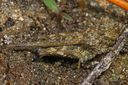
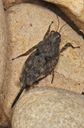
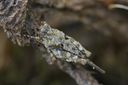
Paratettix mexicanus is a of pygmy in the Tetrigidae. It is one of the most frequently observed Tetrigidae species in North America on citizen science platforms. The species belongs to a family that has existed for over 230 million years, making pygmy grasshoppers one of the oldest lineages of modern insects.
Pronunciation
How to pronounce Paratettix mexicanus: /ˌpærəˈtɛtɪks ˌmɛksɪˈkeɪnəs/
These audio files are automatically generated. While they are not always 100% accurate, they are a good starting point.
Identification
As a member of Paratettix, this can be distinguished from the related genus Tetrix by subtle morphological characters. Identification to species level requires examination of pronotal structure and genitalia. The pronotum in Paratettix species typically extends backward over the , though the specific modifications for P. mexicanus have not been detailed in accessible literature.
Images
Habitat
Members of Paratettix are typically found in moist environments near water bodies. Based on -level characteristics, this likely includes such as pond margins, stream edges, and wet leaf litter.
Distribution
Documented from the Nearctic region including the United States (Alabama, Arizona, California, Florida) and Guatemala in Central America. The distribution spans from southern United States through Central America.
Life Cycle
As with all Tetrigidae, this undergoes with , nymph, and stages. Nymphs resemble small adults but lack fully developed wings and reproductive organs.
Ecological Role
Pygmy grasshoppers contribute to leaf litter decomposition and serve as prey for small vertebrates and in moist .
Human Relevance
This has been documented through citizen science observations on the iNaturalist platform, contributing to understanding of Nearctic Tetrigidae diversity. It is not known to be of agricultural or medical significance.
Similar Taxa
- Paratettix meridionalisBoth are western Palearctic and Nearctic Paratettix ; P. meridionalis occurs in the Mediterranean region while P. mexicanus occurs in the Americas
- Tetrix speciesSimilar small size and preference; Tetrix differ in pronotal and genitalic characters, and are more diverse in the Palearctic region
Misconceptions
Pygmy grasshoppers are frequently mistaken for grasshoppers of larger due to their small size (approximately 1 cm). Adult Paratettix mexicanus are fully mature at this size.
More Details
Research significance
Paratettix mexicanus is among the 19 most-observed Tetrigidae on iNaturalist globally, with 111 research-grade observations as of 2021. This reflects both its actual abundance and the concentration of naturalist activity in North America, as the majority of Tetrigidae diversity occurs in tropical regions with far less documentation.