
Tettigidea prorsa
Scudder, 1877
cone-head pygmy grasshopper, coneheaded grouse locust
Tettigidea prorsa is a North American of pygmy in the Tetrigidae. It is commonly known as the cone- pygmy grasshopper or coneheaded grouse locust. The species was described by Scudder in 1877. As a member of the Tetrigidae, it belongs to an ancient family that has existed for over 230 million years.
Pronunciation
How to pronounce Tettigidea prorsa: /tɛtɪˈɡiːdə ˈprɔrsa/
These audio files are automatically generated. While they are not always 100% accurate, they are a good starting point.
Identification
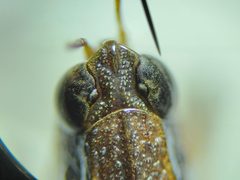
The Tettigidea can be distinguished from other North American Tetrigidae genera by its characteristic pronotum shape. Members of this genus typically have a pronotum that extends backward over the . Tettigidea prorsa specifically is characterized by its cone-headed appearance, which gives rise to its . The name "prorsa" refers to this forward-projecting or cone-like pronotal structure.
Images
Distribution
North America. Distribution records indicate presence in Georgia and the broader North American region.
Similar Taxa
- Tettigidea lateralisAnother North American in the same , commonly known as the black-sided pygmy . T. lateralis has bold white femoral markings and is often found in similar near streams and wet areas, but can be distinguished by its lateral dark markings and different pronotal shape.
- Tetrix speciesEuropean and Holarctic pygmy grasshoppers that share the Tetrigidae and similar small size and jumping ability, but belong to a different with different pronotal and are not native to North America.
More Details
Taxonomic history
The was first described by Samuel Hubbard Scudder in 1877, a prominent American entomologist who made significant contributions to the study of Orthoptera. The specific epithet "prorsa" is Latin, meaning "forward" or "ahead," referring to the projecting cone-like structure of the pronotum.
Observation status
As of available records, this has relatively few documented observations (2 records in iNaturalist), suggesting it may be underreported, cryptic in habits, or genuinely uncommon. This pattern is typical for many Tetrigidae species, which are often overlooked due to their small size and effective camouflage.
Sources and further reading
- BugGuide
- Wikipedia
- GBIF taxonomy match
- iNaturalist taxon
- Catalogue of Life
- Tetrigidae | Beetles In The Bush
- July | 2011 | Beetles In The Bush | Page 2
- Orthoptera | Beetles In The Bush | Page 5
- crypsis | Beetles In The Bush | Page 2
- The mini grasshoppers that outlived dinosaurs: the fascinating world of Tetrigidae | Blog
- A “Giant” Pygmy | Beetles In The Bush