
Trimerotropis huroniana
Walker, 1902
Lake Huron Locust, Great Lakes Grasshopper
A band-winged grasshopper to the Great Lakes region, restricted to open dune along the shores of Lakes Huron, Michigan, and Superior. Body length ranges from 24–40 mm with females larger than males. are active from late July through August. Federally listed as Threatened in Canada under the At Risk Act, with approximately 10 known sites remaining in Ontario.
Pronunciation
How to pronounce Trimerotropis huroniana: /ˌtraɪmɛˈrɒtrɒpɪs ˌhjʊrəˈnɪənə/
These audio files are automatically generated. While they are not always 100% accurate, they are a good starting point.
Identification
Distinguished from other Trimerotropis by its strict association with Great Lakes dune . Replaced by T. maritima along parts of the southern shore of Lake Michigan with minimal range overlap. Pale yellow, black, and translucent hind wing pattern may aid identification, though this trait is shared with other band-winged grasshoppers in the . Historical confusion with T. maritima in the Thumb region of Michigan has been resolved by recent surveys showing neither species currently present there.
Images
Appearance
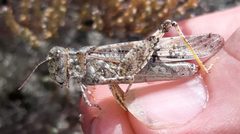
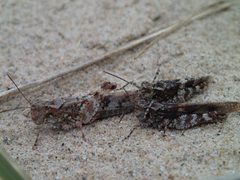
Grey to brown in coloration. Hind wings are pale yellow, black, and translucent. Body length 24–40 mm, with females generally larger than males.
Habitat
Open dune along the shorelines of Lake Huron, Lake Michigan, and Lake Superior. Sandy substrates with sparse vegetation including dune grasses.
Distribution
to the Great Lakes region of North America. In the United States: Wisconsin and Michigan. In Canada: Ontario, where it is federally listed as Threatened. Known Canadian sites include Pancake Bay, Manitoulin Island, and Great Duck Island. Historical existed at Traverse City, Wasaga Beach, Sauble Beach, and Giant Tomb's Island, but current status at these locations is unknown.
Seasonality
present from late July through August. laid in sand overwinter and emerge as nymphs the following spring. Development through 5 instars before reaching adulthood.
Diet
Has been observed feeding on Ammophila brevigulata, Calamovilfa longifolia, and Artemisia campestris.
Life Cycle
are deposited in sand where they overwinter. Nymphs emerge in spring and progress through 5 instars before reaching adulthood in late July to August.
Behavior
Males court females through stridulation and display .
Ecological Role
Herbivore in dune . Specific ecological functions beyond herbivory have not been documented.
Human Relevance
Subject to conservation concern due to restriction and limited distribution. Federally listed as Threatened in Canada under the At Risk Act. Habitat loss from shoreline development and dune stabilization likely contribute to decline.
Similar Taxa
- Trimerotropis maritimaReplaces T. huroniana along parts of the southern shore of Lake Michigan with very little range overlap. Historical records indicated potential confusion in the Thumb region of Michigan, though neither is currently present there.
More Details
Conservation Status
Approximately 10 known sites remain in Canada. Historical at several locations (Traverse City, Wasaga Beach, Sauble Beach, Giant Tomb's Island) have not been confirmed in recent surveys.