
Phlibostroma quadrimaculatum
(Thomas, 1871)
Four-spotted Grasshopper, Four-spotted tree cricket, P-quad grasshopper
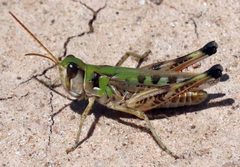
Phlibostroma quadrimaculatum, commonly known as the four-spotted grasshopper, is a North American grasshopper in the Gomphocerinae. It inhabits grassland in the western United States and adjacent Mexico. The species has been documented in affecting rangeland forage, though it is typically subdominant in mixed-species . It is recognized by the four dark spots on its surface.
Pronunciation
How to pronounce Phlibostroma quadrimaculatum: /ˌflɪboʊˈstroʊmə ˌkwɑd.rɪ.mæˈkjʊ.leɪ.təm/
These audio files are automatically generated. While they are not always 100% accurate, they are a good starting point.
Identification
Distinguished from and similar gomphocerine grasshoppers by the presence of four dark spots on the surface. In the field guide sequence, it follows Orphulella speciosa and precedes Psoloessa delicatula in the . Specific structural characters distinguishing it from other Phlibostroma are not detailed in available sources.
Images
Habitat
Inhabits grassland including mixedgrass prairie, shortgrass prairie, and desert prairie. In the San Rafael Valley, Arizona, it has been found in desert prairie habitat at elevations around 5,000 feet. Occurs in areas with grasses forming the vegetation.
Distribution
Recorded from Colorado, Nebraska, New Mexico, Oklahoma, and northeastern Mexico. Distribution is centered in the western Great Plains and southwestern United States.
Diet
Feeds on grasses. In the San Rafael Valley, Arizona, crop contents have included blue grama, buffalograss, and other grass . Specific dietary preferences have not been extensively documented.
Ecological Role
A member of grassland . During conditions, contributes to overall herbivory pressure on rangeland vegetation. In the 1956 San Rafael Valley, Arizona outbreak, comprised part of an assemblage estimated at 46 young per square yard, with P. quadrimaculatum contributing 4.6 individuals per square yard (10% of the assemblage).
Human Relevance
Considered a potential pest of rangeland forage during years. Participated in a severe 1955 outbreak in western Oklahoma alongside Ageneotettix deorum, Aulocara elliotti, and Boopedon nubilum. In the 1956 Arizona outbreak, the including this caused estimated forage losses of 600 lb dry weight per acre. Normally subdominant in grasshopper assemblages and of limited economic significance at typical densities.
Similar Taxa
- Psoloessa delicatulaBoth are small gomphocerine grasshoppers of western grasslands with spotted coloration. P. delicatula has brown spots and maculations rather than four distinct spots, and possesses a grooved frontal and specific pronotal carinae structure not described for P. quadrimaculatum.
- Orphulella speciosaAdjacent in sequence. O. speciosa has a strongly slanted , small semicircular depression of the vertex close to the front, and lateral carinae of the pronotum incised once. P. quadrimaculatum is distinguished by its four spots.
More Details
Population Density in Outbreaks
In the 1956 San Rafael Valley , was estimated at 4.6 young per square yard, representing approximately 10% of the total . This is substantially lower than co-occurring such as Boopedon flaviventris (13.4 per square yard) and Melanoplus lakinus (19 per square yard).
Nomenclature
Referred to colloquially as 'P-quad' in some management contexts, reflecting both the abbreviation and the four-spotted pattern.