
Paropomala
Scudder, 1899
toothpick grasshoppers
Species Guides
3- Paropomala pallida(Pale Toothpick Grasshopper)
- Paropomala virgata(virgata toothpick grasshopper)
- Paropomala wyomingensis(Wyoming toothpick grasshopper)
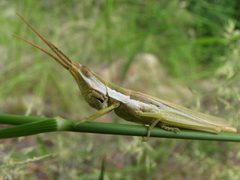
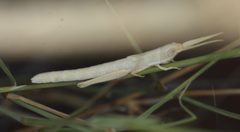
Paropomala is a of North in the Gomphocerinae, commonly known as toothpick grasshoppers. The genus contains at least three described : P. pallida (pale toothpick ), P. virgata (virgata toothpick grasshopper), and P. wyomingensis (Wyoming toothpick grasshopper). Species in this genus are primarily associated with grassland in the western United States.
Pronunciation
How to pronounce Paropomala: //ˌpæroʊˈpɒmələ//
These audio files are automatically generated. While they are not always 100% accurate, they are a good starting point.
Identification
Members of Paropomala can be distinguished from similar Gomphocerinae by their slender, elongate body form consistent with the "toothpick" . The genus is placed in the slant-faced grasshopper group based on classification. -level identification requires examination of specific morphological characters; P. wyomingensis is known to occur in shortgrass prairies of eastern Wyoming, with diminishing in mixedgrass prairie and desert regions.
Images
Habitat
in this inhabit grassland , particularly shortgrass prairies. Paropomala wyomingensis is specifically documented from shortgrass prairie in eastern Wyoming, with reduced abundance in mixedgrass prairie and desert regions of the state.
Distribution
The is distributed in North America, with records from Arizona, California, Colorado, Indiana, and northeastern Mexico. The type and related are primarily western in distribution, with P. wyomingensis documented in Wyoming and surrounding regions.
Seasonality
For P. wyomingensis, are present from mid-July to early September. overwinter in the soil. Seasonality for other in the is not documented in available sources.
Diet
P. wyomingensis feeds on multiple grass including western wheatgrass (Pascopyrum smithii), grama grasses (Bouteloua spp.), and needle-and-thread grass (Hesperostipa comata). Dietary information for other Paropomala species is not available.
Host Associations
- Pascopyrum smithii - food plantwestern wheatgrass
- Bouteloua - food plantgrama grasses
- Hesperostipa comata - food plantneedle-and-thread grass
Life Cycle
P. wyomingensis overwinters as in the soil. Nymphal development and timing result in adult presence from mid-July to early September. details for other are not documented.
Ecological Role
As a grass-feeding insect in prairie , P. wyomingensis contributes to nutrient cycling and serves as a food source for vertebrate and . It is rarely abundant but may contribute to rangeland forage reduction when occurring with other .
Human Relevance
P. wyomingensis has minor significance as a potential rangeland pest. It is rarely abundant individually but could damage forage in conjunction with other . The has no other documented economic or cultural importance.
Similar Taxa
- PseudopomalaBoth are in Gomphocerinae and share slender body forms; Paropomala is distinguished by specific genitalic and tegminal characters (requires expert examination)
- AmphitornusBoth are slant-faced Gomphocerinae grasshoppers with western distributions; Amphitornus coloradus (striped slant-faced grasshopper) has distinct color patterning and different pronotal structure
More Details
Taxonomic Note
The Paropomala was established by Scudder in 1899. Some sources cite Otte (1981) as an authority, reflecting subsequent taxonomic revision work. The genus is definitively placed in Gomphocerinae based on multiple sources.
Species Diversity
At least three are described: P. pallida (pale toothpick , described by Bruner 1904), P. virgata (virgata toothpick grasshopper, described by Scudder 1899), and P. wyomingensis (Wyoming toothpick grasshopper, described by Thomas 1871).