
Ligurotettix coquilletti
McNeill, 1897
desert clicker grasshopper, creosote bush grasshopper
A slant-faced grasshopper specialized on creosote bush (Larrea tridentata) across the southwestern deserts of North America. Males are highly territorial, defending individual plants as mating territories through acoustic stridulation. The species exhibits a distinctive evening chorus and maintains a color (banded and uniform morphs) shaped by pressure. Females oviposit in bare soil away from host plants, and the species undergoes winter .
Pronunciation
How to pronounce Ligurotettix coquilletti: //ˌlɪɡəroʊˈtɛtɪks koʊˈkwiːjəti//
These audio files are automatically generated. While they are not always 100% accurate, they are a good starting point.
Identification
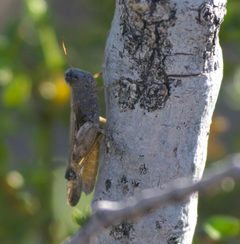
A small to medium slant-faced grasshopper (18–25 mm) with cryptic gray coloration matching desert substrates. Distinguished from other slant-faced grasshoppers by its strict association with creosote bush and the male's distinctive low 'tsick-tsick' stridulatory call with ventriloquistic quality. Color includes banded and uniform morphs, with banded morphs correlated with a large genetic indel.
Images
Habitat
Arid desert environments dominated by creosote bush (Larrea tridentata); also found on mesquite (Prosopis spp.), jojoba (Simmondsia chinensis), allscale (Atriplex polycarpa), and sagebrush (Artemisia spp.). Females use bare desert substrate for oviposition, separate from feeding sites.
Distribution
Western North America from California to Texas and southward; specifically the Mojave and Sonoran deserts. Records from Arizona, California, Nevada, and Central America.
Seasonality
undergo winter , hatching March–April. Nymphs progress through five or six instars. present May–June, with male singing activity from early morning through evening, peaking at dusk (15–40 minutes post-sunset).
Diet
Feeds primarily on Larrea tridentata (creosote bush); has been observed on mesquite, jojoba, allscale, and sagebrush.
Host Associations
- Larrea tridentata - primary plantcreosote bush; primary feeding and territorial site for males
- Prosopis spp. - secondary mesquite
- Simmondsia chinensis - secondary jojoba
- Atriplex polycarpa - secondary allscale
- Artemisia spp. - secondary sagebrush
Life Cycle
laid in bare soil undergo winter . Nymphs hatch March–April and pass through five or six nymphal stages. emerge May–early June.
Behavior
Males are highly sedentary, spending most of life on a single creosote bush. Defend individual plants as mating territories through acoustic stridulation using pegs on the inner hind . Territorial defense escalates from signaling to chasing to physical combat. Males produce bimodal daily activity with intense evening chorus; singing rate at dusk equals or exceeds midday rates. Females are attracted to male songs and relocate to host plants at dusk, synchronizing with male signaling.
Ecological Role
Herbivore specializing on creosote bush; prey for ground-foraging . Color maintained by through local balancing selection.
Similar Taxa
- Other Gomphocerinae slant-faced grasshoppersL. coquilletti distinguished by strict creosote bush association, distinctive male acoustic signal, and territorial on individual plants.
- Other Ligurotettix speciesGeographic distribution and plant specificity differ; L. coquilletti is the associated with Larrea tridentata in the Mojave and Sonoran deserts.
Sources and further reading
- BugGuide
- Wikipedia
- GBIF taxonomy match
- iNaturalist taxon
- NCBI Taxonomy
- Catalogue of Life
- Bug Spotlight | Entomology Research Museum
- Field Guide Selected References
- Coquillettia vicina Wyniger lateral | Entomology Research Museum
- Bembicid Holdings | Entomology Research Museum
- Primary Type List | Entomology Research Museum
- Bug Eric: Wasp Wednesday: Poecilopompilus algidus
- Ecological basis and genetic architecture of crypsis polymorphism in the desert clicker grasshopper ( Ligurotettix coquilletti )
- The Evening Chorus of the Desert Clicker, Ligurotettix coquilletti (Orthoptera: Acrididae): Mating Investment with Delayed Returns