
Ligurotettix
McNeill, 1897
Clicker Grasshoppers
Species Guides
2- Ligurotettix coquilletti(desert clicker grasshopper)
- Ligurotettix planum(Pecos Clicker Grasshopper)
Ligurotettix is a of clicker grasshoppers in the Acrididae, Gomphocerinae, containing at least two described : L. coquilletti (desert clicker ) and L. planum (Pecos clicker grasshopper). Members are known for their distinctive acoustic territorial displays. The genus is distributed across southwestern North American deserts.
Pronunciation
How to pronounce Ligurotettix: /ˌlɪɡjʊroʊˈtɛtɪks/
These audio files are automatically generated. While they are not always 100% accurate, they are a good starting point.
Identification
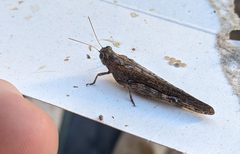
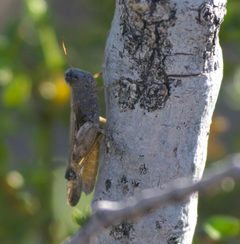
Distinguished from other slant-faced grasshoppers by the row of stridulatory pegs on the inside of the hind used to produce the characteristic clicking sounds. Males produce a low 'tsick-tsick' stridulation with ventriloquistic quality. Specific identification requires examination of morphological details; L. coquilletti is dark gray, 18–25 mm in length, with transparent hind wings.
Images
Habitat
Arid and semi-arid desert environments. L. coquilletti is most commonly associated with creosote bush (Larrea tridentata), but also occurs on mesquite (Prosopis spp.), jojoba (Simmondsia chinensis), allscale (Atriplex polycarpa), and sagebrush (Artemisia spp.). Females oviposit in bare soil in open areas away from plants.
Distribution
Southwestern North America, including California, Arizona, Nevada, Texas, and southward into Mexico. GBIF records indicate presence in Arizona, California, Mexico Northeast, and Nevada.
Seasonality
present in May or early June. undergo during winter, hatching in March or April. Immatures pass through five or six nymphal stages before reaching adulthood.
Diet
Feeds on creosote bush (Larrea tridentata) and other desert shrubs including mesquite, jojoba, allscale, and sagebrush. Has a restricted range of plants compared to many other grasshoppers.
Host Associations
- Larrea tridentata - primary plantcreosote bush; males defend individual bushes as territories
- Prosopis spp. - plantmesquite
- Simmondsia chinensis - plantjojoba
- Atriplex polycarpa - plantallscale
- Artemisia spp. - plantsagebrush
Life Cycle
deposited in bare soil in open areas; undergo winter . Hatch in March or April. Five to six nymphal instars before . Adults appear May to early June.
Behavior
Males are highly sedentary, spending most of their lives on a single creosote bush. Defend individual plants as mating territories through three-tiered territorial defense: stridulation, chasing, and fighting. Males produce repetitive acoustic clicking displays (stridulations) used for territorial advertisement; singing occurs early morning through late evening, dependent on temperature, with peak activity at dusk. Females are attracted to male songs but do not sing. Activity schedules are bimodal with midday plateau and sharp peak; evening chorus represents mating investment with delayed returns.
Ecological Role
Herbivore feeding on desert shrubs. Serves as prey for ground-foraging ; subject to -driven balancing selection maintaining color (banded and uniform morphs). polymorphism provides camouflage against visually hunting predators.
Similar Taxa
- Other Gomphocerinae slant-faced grasshoppersShares slanted and stridulatory pegs on hind ; distinguished by specific acoustic signals and plant associations
- Other Acrididae grasshoppersDistinguished by territorial on individual plants and distinctive 'clicker' acoustic displays
Sources and further reading
- BugGuide
- Wikipedia
- GBIF taxonomy match
- iNaturalist taxon
- NCBI Taxonomy
- Catalogue of Life
- Bug Spotlight | Entomology Research Museum
- Field Guide Selected References
- Ecological basis and genetic architecture of crypsis polymorphism in the desert clicker grasshopper ( Ligurotettix coquilletti )
- The Evening Chorus of the Desert Clicker, Ligurotettix coquilletti (Orthoptera: Acrididae): Mating Investment with Delayed Returns