
Schistocerca shoshone
(Thomas, 1873)
green bird grasshopper, green valley grasshopper
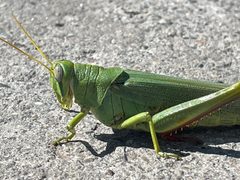
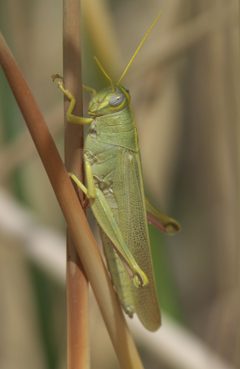
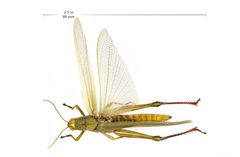
Schistocerca shoshone is a large in the bird grasshopper group, recognized by its green coloration. The exhibits notable dietary plasticity: while fundamentally , have been observed specializing on single plants including Simmondsia and Prosopis when these dominate local vegetation. Genetic differences between populations may underlie this feeding variation. It ranges across southwestern North America and has been documented as far north as Colorado.
Pronunciation
How to pronounce Schistocerca shoshone: //ˌskɪstəˈsɜːrkə ʃoʊˈʃoʊni//
These audio files are automatically generated. While they are not always 100% accurate, they are a good starting point.
Images
Habitat
Riparian areas and desert environments. Observed along river edges clinging to cattails and grasses, as well as in desert plantations and mountainous desert regions.
Distribution
Southwestern United States and northwestern Mexico. Documented in Arizona, California, Utah, Colorado, and Mexico (Northwest region).
Diet
but capable of monophagy. Field show flexible feeding: riparian insects eat plants roughly in proportion to availability (avoiding broad-leaved herbaceous plants), while desert populations may specialize exclusively on woody plants such as Simmondsia or Prosopis. Laboratory experiments confirm acceptance of Simmondsia and Prosopis; other common woody plants from the are generally rejected without feeding.
Host Associations
- Simmondsia - food plantexclusive for some desert
- Prosopis - food plantmain for Portal, Arizona
Behavior
Exhibits -dependent behavioral plasticity typical of the . Capable of long-distance ; individuals have been observed colliding with observers after leaping from ground vegetation.
Similar Taxa
- Schistocerca obscurasimilar large size and general appearance; S. shoshone distinguished by green coloration and more western distribution
- Schistocerca alutaceaboth are 'bird grasshoppers' in the same ; S. shoshone lacks the spotted wing pattern of S. alutacea
More Details
Feeding specialization
Despite being classified as , S. shoshone shows -level feeding specialization that appears genetically based rather than induced by experience. This makes it a notable example of monophagy evolving within a polyphagous .
Locust potential
As a member of Schistocerca, which includes the (S. gregaria), this possesses the biological machinery for -dependent phase , though it is not known to form destructive swarms.
Sources and further reading
- BugGuide
- Wikipedia
- GBIF taxonomy match
- iNaturalist taxon
- NCBI Taxonomy
- Catalogue of Life
- Grasshoppers of Colorado
- Bug Eric: The Obscure Bird Grasshopper
- Bug Eric: The Tarantula Hunt
- Bug Eric: New Mexico Dragonfly Blitz - Day 3
- Swarm Shift: How Locusts Switch Phases When Numbers Swell
- Can a Swarm of Locusts Really Block Out the Sun?
- Monophagy in a polyphagous grasshopper, Schistocerca shoshone