
Schistocerca pallens
(Thunberg, 1815)
bird grasshopper
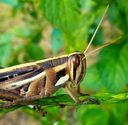
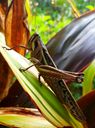
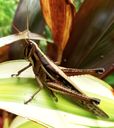
Schistocerca pallens is a large bird distributed throughout tropical America. Unlike its close relative Schistocerca cancellata, it lacks locust phase and does not form swarms even under crowded laboratory conditions. It remains capable of reaching densities high enough to cause significant agricultural damage, particularly to sugar cane and other crops. The serves as a natural for the fungus Metarhizium flavoviride, which has been investigated for potential.
Pronunciation
How to pronounce Schistocerca pallens: //ˌʃɪstəˈsɜrkə ˈpælənz//
These audio files are automatically generated. While they are not always 100% accurate, they are a good starting point.
Identification
Closely resembles Schistocerca cancellata but lacks the phase characteristic of true locusts; specific diagnostic features for field identification are not documented in available sources.
Images
Habitat
Agricultural areas including crop fields and cultivated pastures; occurs in tropical environments throughout its range. In Brazil, found in both Northeast and Central regions, with notably lower densities in Central Brazil.
Distribution
Tropical America, including Brazil (Northeast and Central regions), Colombia, Rica, Cuba, and West-central and Southeast Brazil. Occurs throughout tropical America with few exceptions.
Diet
Recorded feeding on sugar cane, almond, banana, beans, breadfruit, carnauba wax palm, chickpeas, coconut palms, cotton, forage crops, groundnuts, indigo, legumes, maize, onions, rice, sorghum, sweet potato, and tomatoes.
Host Associations
- Metarhizium flavoviride - Natural fungus with potential for ; Brazilian isolates from S. pallens show high genetic homogeneity (≥98.3% similarity)
- Rhammatocerus schistocercoides - alternative Alternative for M. flavoviride isolate CG423
- Stiphra robusta - alternative Alternative for M. flavoviride ()
Behavior
Does not exhibit swarming or locust phase even under crowded laboratory conditions. Capable of long-distance typical of bird grasshoppers. Occurs at low densities in Central Brazil compared to Northeast Brazil where it is a serious pest.
Ecological Role
Agricultural pest; natural for fungus Metarhizium flavoviride. High genetic variability within (2.2-2.3% diversity) but minimal genetic distinction between geographically separated populations.
Human Relevance
Economic pest of agriculture, primarily damaging sugar cane but with recorded impacts on diverse crops including cereals, legumes, fruits, and vegetables. Subject of research using its natural Metarhizium flavoviride.
Similar Taxa
- Schistocerca cancellataClosely related and morphologically similar, but S. cancellata exhibits locust phase and swarming while S. pallens does not, even under crowded conditions
- Schistocerca gregariaBoth are large Schistocerca , but S. gregaria is the Old World with pronounced phase , whereas S. pallens is a New World non-swarming species
More Details
Genetic Variability
RAPD analysis reveals high intrapopulational genetic variability (2.3% diversity in Rio Grande do Norte, 2.2% in Federal District) but almost no genetic divergence (0.004) between Northeast and Central Brazilian , suggesting across its range.
Sources and further reading
- BugGuide
- Wikipedia
- GBIF taxonomy match
- iNaturalist taxon
- NCBI Taxonomy
- Catalogue of Life
- Grasshoppers of Colorado
- Grasshoppers of Colorado
- Grasshoppers of Colorado
- Grasshoppers of Colorado
- Bug Eric: The Obscure Bird Grasshopper
- Swarm Shift: How Locusts Switch Phases When Numbers Swell
- Laboratory studies on the effect of crowding on phase and the life history ofSchistocerca pallens(Thunberg) (Orthoptera: Acrididae: Cyrtacanthacridinae)
- Polymorphism of the grasshopper Schistocerca pallens (Thunberg) (Orthoptera: Acrididae) and its natural pathogen Metarhizium flavoviride Gams & Rozsypal (Hyphomycetes), revealed by RAPD analysis