
Lestes rectangularis
Say, 1840
slender spreadwing
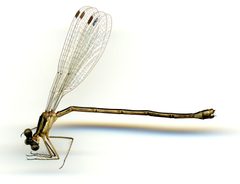
Lestes rectangularis, commonly known as the slender spreadwing, is a in the Lestidae. It is native to eastern North America, ranging from eastern Canada through the eastern United States. The species is characterized by its elongated, slender body form and distinctive wing posture at rest, with wings held partially spread rather than folded together above the . It inhabits springs and temporary pond , where it completes its aquatic larval development before emerging as a flying .
Pronunciation
How to pronounce Lestes rectangularis: //ˈlɛstiːz rɛˌktæŋˈɡjʊlərɪs//
These audio files are automatically generated. While they are not always 100% accurate, they are a good starting point.
Identification
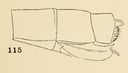
Distinguished from other Lestes by the combination of slender body form, black body with pale blue , and yellow-edged wings. The female's larger size and paler yellow wing edges provide additional diagnostic characters. The species' eastern North American distribution helps separate it from western . Wing venation and abdominal segment proportions may provide further distinguishing features, though specific characters require close examination.
Images
Appearance
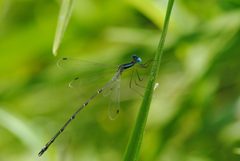
Elongated, slender body with black coloration and pale blue . Wings have yellow edges. Females are larger than males and display paler yellow wing coloration. The exhibits the characteristic spreadwing posture, with wings held at an angle away from the body when at rest rather than folded together above the .
Habitat
Inhabits springs and drying ponds. Associated with shallow, vegetated freshwater that may be temporary or seasonal in nature. The shows adaptability to habitats with fluctuating water levels.
Distribution
Native to eastern North America, including eastern Canada and the eastern United States. Records confirm presence in Vermont and broader eastern North American range.
Life Cycle
Aquatic larval stage (naiad) develops in freshwater before emerging as a winged . Specific details of deposition, larval duration, and timing are not documented in available sources.
Behavior
hold wings in partially spread posture when at rest, a characteristic of the Lestidae. This distinguishes them from most , which fold wings together above the .
Ecological Role
Predatory both as aquatic naiads and as aerial . Naiads consume aquatic ; adults capture small flying insects. Serves as prey for various aquatic and terrestrial including fish, birds, and other insects.
Human Relevance
Subject of ecological research, particularly regarding seasonal regulation of . Observed by naturalists and enthusiasts in its native range.
Similar Taxa
- Other Lestes speciesShare spreadwing wing posture and general body form; distinguished by specific coloration, size, and geographic distribution
- Other damselfly families (e.g., Coenagrionidae)Overlap in and general appearance; distinguished by wing posture at rest—Lestidae hold wings spread, while most other fold wings together above
More Details
Research interest
The has been subject of ecological research regarding seasonal regulation of its , as indicated by a 1939 journal publication.
Sources and further reading
- BugGuide
- Wikipedia
- GBIF taxonomy match
- iNaturalist taxon
- NCBI Taxonomy
- Catalogue of Life
- Bug Eric: Bosque del Apache National Wildlife Refuge
- Bug Eric: January 2016
- Canvey Wick - February Projects with the South East England Youth Nature Network - Buglife Blog - Buglife
- Bug Eric: New Mexico Dragonfly Blitz - Day 3
- Life History of Damselfly Lestes rectangularis with Special Reference to Seasonal Regulation